






The European Union Deforestation Regulation (EUDR) mandates that, starting in 2025, specific products placed on or exported from the EU market must be proven deforestation-free. To ensure rigorous verification, products are classified based on HS Codes (Harmonized System), covering not only core commodities but also hundreds of derived sub-categories. This guide provides a clear breakdown of which products fall under EUDR, the relevant HS codes, derivative inclusions, and common misconceptions.
The Verdict: EUDR Covers the Entire Product Lifecycle, Not Just Commodities EUDR compliance extends far beyond raw materials; it encompasses every link in the chain—produced, processed, or traded. Consequently, businesses are responsible for more than just the final “product sale”; they must account for supply chains, packaging, by-products, and animal feed. If your product falls within these categories, reporting geographic coordinates, documenting legal sourcing, and conducting risk assessments are non-negotiable requirements.
Mastering the complexities of EUDR by securing every link from raw commodity to finished derivative. Empowering your business with high-precision traceability to ensure seamless access to the European market.
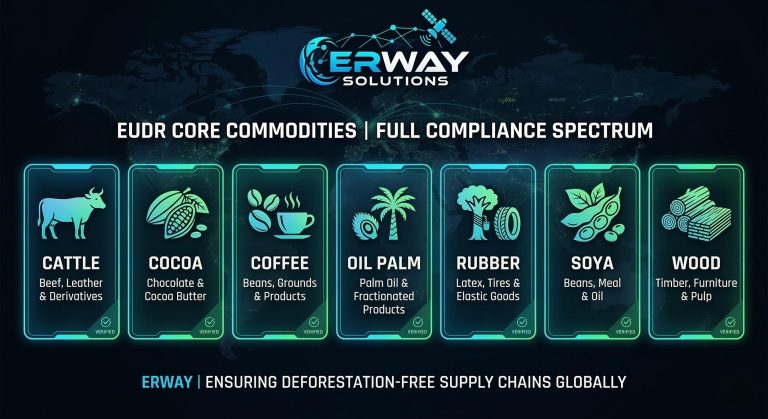
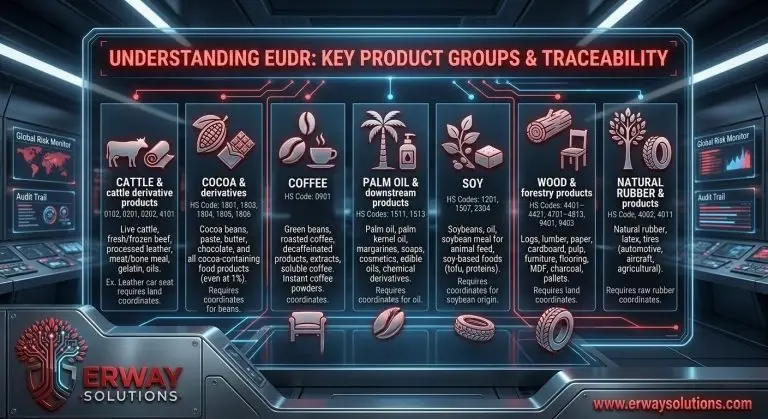
Cattle (Beef & Leather)
The Details: EUDR doesn’t just watch the meat; it monitors the land where the cattle grazed. Any “forest-to-pasture” conversion after December 31, 2020, renders the product non-compliant.
Real-Life Example: A French luxury fashion house importing bovine leather (HS Code 4107) for handbags. To comply, they must provide the precise geolocation coordinates of every farm where the cattle were raised to prove no forest was cleared for grazing.
Cocoa (Beans & Chocolate)
The Details: This covers everything from raw beans to finished chocolate bars. Large-scale agricultural expansion is a primary driver here.
Real-Life Example: A German confectionery brand sourcing cocoa butter (HS Code 1804). They must use ERWAY’s satellite monitoring to verify that the cocoa plantations in West Africa have not encroached into protected rainforest areas over the last five years.
Coffee (Roasted & Unroasted)
The Details: Coffee is a high-risk commodity due to its cultivation in biodiversity hotspots. Compliance requires evidence of both legality and land-use integrity.
Real-Life Example: An Italian roaster importing roasted Arabica beans (HS Code 0901.21). They need an automated DDS (Due Diligence Statement) that links the specific batch of beans to a verified, deforestation-free polygon map of the farm.
Oil Palm (Palm Oil & Derivatives)
The Details: This is the most complex category due to the sheer number of derivatives used in food, cosmetics, and biofuels.
Real-Life Example: A Dutch food manufacturer using refined palm oil (HS Code 1511) in snack production. They must track the oil back to the specific mill and the supplying plantations to ensure no primary forest was cleared for palm cultivation.
Rubber (Natural Rubber & Tires)
The Details: This is the most complex category due to the sheer number of derivatives used in food, cosmetics, and biofuels.
Real-Life Example: A Dutch food manufacturer using refined palm oil (HS Code 1511) in snack production. They must track the oil back to the specific mill and the supplying plantations to ensure no primary forest was cleared for palm cultivation.
Soya (Beans & Animal Feed)
The Details: Most soy enters the EU as animal feed. The challenge is “mass balance” vs. “segregation” in the supply chain.
Real-Life Example: A Spanish poultry producer importing soya-bean oilcake (HS Code 2304) for feed. They must verify that the soy was grown on legally registered land that hasn’t seen deforestation, a task simplified by ERWAY’s geospatial validation.
Wood (Furniture, Paper & Pulp)
The Details: This covers a massive range of products from raw logs to printed books and wooden furniture.
Real-Life Example: A Scandinavian retailer selling wooden dining tables (HS Code 9403.60). They must provide the geolocation of the harvest site and proof that the timber was harvested in accordance with the local laws of the country of production.