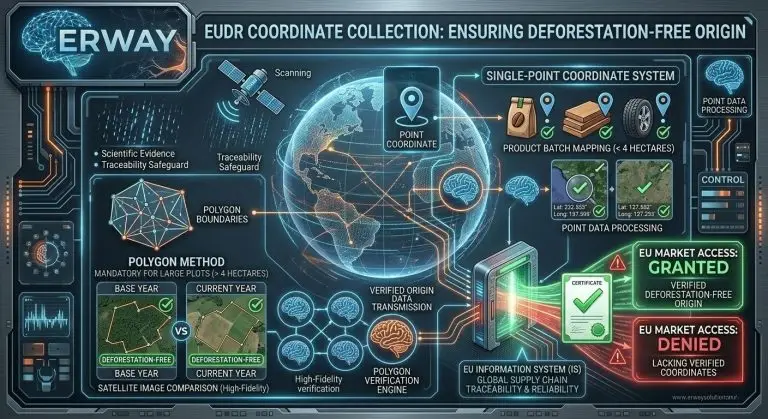






The European Union Deforestation Regulation (EUDR) is more than just an environmental policy; it is a powerful regulation reshaping the future of international trade. It is built on the fundamental principle: “The origin of every product must be fully known and proven.” Moving forward, every product destined for the EU market must be registered alongside the precise geographic coordinates of the land where it was produced. These coordinates serve as scientific evidence that the product originated from a region free of deforestation.
Under EUDR, companies must define production areas using either the polygon method (mandatory for plots exceeding 4 hectares) or a single-point coordinate system. The polygon method outlines the actual boundaries of the land, enabling high-fidelity verification via satellite imagery. This approach maximizes transparency and reliability within the global supply chain.
The EUDR traceability system safeguards not only environmental conservation but also commercial sustainability and the right to access the European market. A product without declared geographic coordinates cannot be imported into, sold within, or exported from the EU. This elevates EUDR to a “mandatory compliance standard” for all global enterprises.
Supported by digital mapping, GNSS technologies, and location-based mobile applications, the EUDR process provides firms with a competitive edge, brand reputation, and legal security. However, it also brings significant responsibilities: operators are solely liable for the accuracy of coordinate data, and misleading declarations can result in severe sanctions. Ultimately, the EUDR geographic coordinate mandate is not just a regulatory hurdle—it is a strategic advantage that empowers companies to lead in sustainability while defining the new rules of global competition.