
Cocoa under the EUDR
Cocoa has the cleanest scope of the seven commodities and by some distance the hardest data problem. Six headings, no exclusions, nothing changed in July 2026 — and roughly two million farms to describe before December.

On this page
Cocoa is the commodity people reach for when they want to explain why the EUDR is hard, and they are right, but usually for the wrong reason. The regulation is not ambiguous about cocoa. Its scope is the tidiest of the seven relevant commodities, its geometry requirement is the lenient one, and it gained nothing and lost nothing in the July 2026 revision of Annex I. On paper it is the easiest of the seven.
The difficulty is arithmetic. A mid-sized European chocolate manufacturer buying from West Africa is, when you follow the beans back, sourcing from somewhere between forty thousand and four hundred thousand individual farms, most of which have never appeared in a database, few of which have formal title, and none of which were laid out with a satellite in mind. Nothing about any single one of those farms is complicated. There are simply a great many of them, and the deadline is fixed.
What is in scope
Annex I gives cocoa six entries, and they run the whole way from the raw material to the finished consumer product. There are no partial inclusions — no entry carries the "ex" prefix that elsewhere means only some goods under a code are covered — so classification questions that consume weeks in the rubber and palm sectors barely arise here.
| Code | Product | Applies from |
|---|---|---|
| 1801 | Cocoa beans, whole or broken, raw or roasted | 30 December 2026 |
| 1802 | Cocoa shells, husks, skins and other cocoa waste | 30 December 2026 |
| 1803 | Cocoa paste, whether or not defatted | 30 December 2026 |
| 1804 | Cocoa butter, fat and oil | 30 December 2026 |
| 1805 | Cocoa powder, without added sugar or sweetening | 30 December 2026 |
| 1806 | Chocolate and other food preparations containing cocoa | 30 December 2026 |
Cocoa in Annex I to Regulation (EU) 2023/1115
Heading 1806 is the one that catches people who thought they were out of this. It covers chocolate and other food preparations containing cocoa, which means a biscuit manufacturer importing chocolate coating, a dairy business importing cocoa powder for a drink, and a retailer importing own-label bars are all handling relevant products. The obligation attaches to the goods you place on the market, not to whether you consider yourself a cocoa company.
The July 2026 changes did not touch cocoa
The delegated act the Commission adopted on 13 July 2026 added soluble coffee, palm oleochemicals and frozen cattle tongues, and removed cattle leather and several rubber articles. Cocoa's six headings were left exactly as they were. If you are re-reading your scope analysis because of that act — and you should be — cocoa is the section you can leave alone.
Where the deforestation risk actually sits
Cocoa is a forest crop grown in the forest belt, which is the whole of the problem. It wants the same rainfall, the same temperatures and the same soils that tropical moist forest wants, and the frontier between an established cocoa landscape and standing forest is often a single track. Expansion into forest is not an aberration in the cocoa sector; historically it has been the default way to raise output, because planting new trees on new land has been cheaper than rehabilitating old plantings on old land.
That matters for how you read a risk result. In a soya landscape a cleared block is usually large, square and obvious. In a cocoa landscape it is a two-hectare bite out of a forest edge, adjacent to plantings that have been there for thirty years, and it may belong to a different household than the plot you were actually sourcing from. Small, adjacent and ambiguous is the characteristic shape of cocoa deforestation, and it is exactly the shape that punishes imprecise coordinates.
Cocoa also sits under the full-strength version of the deforestation test. The cut-off is 31 December 2020, and the question is whether the plot was forest then and is agricultural now. Age of planting is not a defence in itself — a farm established in 2015 on land cleared in 2015 is compliant; a farm established in 2015 that was extended across the forest edge in 2022 is not, and the extension is the part your geometry has to capture.
The geometry problem is volume, not difficulty
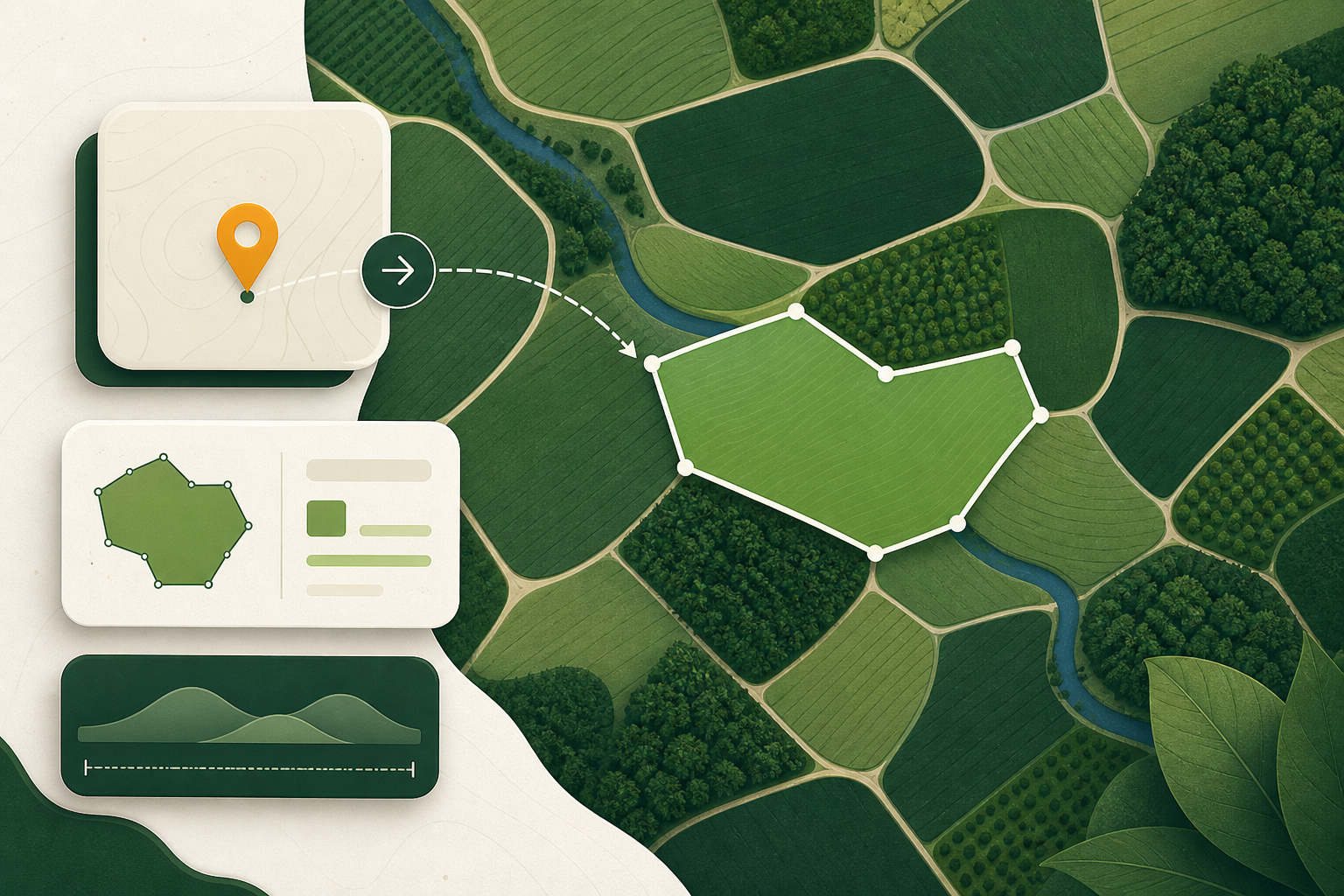
The geolocation rule is the general one. Article 9(1)(d) requires the geolocation of every plot where the commodity was produced, and Article 2(28) allows a single latitude and longitude — to at least six decimal digits — for plots at or below four hectares. Polygons are required above that line. We have written about where that line falls and what sits on either side in general; what is specific to cocoa is which side of it most farms land on.
A typical West African cocoa holding is two to four hectares. That puts the majority of plots under the threshold and entitles you to supply a point. It is the most permissive position any commodity is in — soya operators, whose fields are almost never under four hectares, would take this trade instantly.
It is also a trap in two specific ways, and both are worth understanding before you build a collection programme around points.
- The threshold is per plot, and you cannot apply it until you know the area. A farmer's stated acreage is not a measurement; it is a recollection, often of what was planted rather than what is held. Deciding "under four hectares, therefore a point" on the strength of a declared figure means you have made an unverified regulatory judgement several hundred thousand times.
- A point is a claim about a location, not about an extent. It tells a competent authority where you say the farm is and nothing about where its edges run. When the deforestation sits at a boundary — which in cocoa it usually does — a centroid can fall in clean forest cover while the cleared corner of the same holding never enters the assessment at all.
The eleven-metre problem is worse in cocoa than anywhere else
Four decimal places of latitude is roughly eleven metres on the ground. On a thousand-hectare soya field that is noise. On a two-hectare cocoa plot bordered by forest on two sides it can move your coordinate into a neighbouring block that was cleared in 2022 — and you have then filed a positive, documented assertion about land you never bought from. Precision loss almost never happens in the field; it happens in a spreadsheet export on the way to you.
The practical answer, and the one field programmes converge on once they have collected a first tranche and seen the results, is to walk polygons regardless of size. The marginal cost is small — the enumerator is already standing on the farm, and the difference is a few minutes of walking versus a few seconds of standing still — and it removes both problems at once. Area becomes measured rather than asserted, the four-hectare judgement makes itself, and nobody has to argue about whether a point would have been permissible.
Where the chain stops being traceable
Cocoa's mixing point is early and it is decisive. Beans move from the farm to a village-level buying agent, from the agent to a cooperative or a licensed buying company, and it is at that second step that bags from many farms are pooled into a lot with a single identity. Everything upstream of the pooling is farm-level. Everything downstream is lot-level. No process, audit or certificate applied after pooling can tell you which farm a given bean came from, because that information was not lost through carelessness — it was never carried past the scale.
This has a blunt consequence for how a compliance programme is sequenced. The instinct of a European operator is to start where they have leverage, which is at the exporter, and work backwards. That instinct produces a very well-documented lot and no farm data at all. The work has to be done before pooling, by people who are physically present when the beans are bought, which means the exporter or cooperative is not merely a data source in your programme — it is the only party that can execute it.
It also explains why the second season is dramatically cheaper than the first. Once a cooperative's supply base is mapped, the marginal cost of the next harvest is verifying changes rather than starting again. The expensive part is the census, not the annual maintenance, and the organisations that began mapping in 2023 are now running a materially different cost structure to the ones starting in 2026.
Ghana and Côte d'Ivoire are on different tiers
The country benchmarking in Implementing Regulation (EU) 2025/1093 produced a result the cocoa sector did not expect: Ghana is classified low risk, and Côte d'Ivoire is standard risk. These are adjacent countries, growing the same crop, in the same forest belt, together producing roughly six tenths of the world's cocoa. An operator buying from both is running two different due diligence obligations against one commodity.
| Obligation | Ghana — low risk | Côte d'Ivoire — standard risk |
|---|---|---|
| Article 9 — collect plot geolocation, quantities, supplier details | Required in full | Required in full |
| Article 10 — risk assessment | Not required absent a substantiated concern | Required |
| Article 11 — risk mitigation | Not required absent a substantiated concern | Required where risk is not negligible |
| Due diligence statement | Required | Required |
What the tier changes, and what it does not
The column that matters is the first one. Simplified due diligence under Article 13 removes the assessment and mitigation steps; it does not touch the information-collection duty. A low-risk origin does not reduce by one plot the geometry you have to hold. Teams that read the benchmarking announcement as an exemption and paused their Ghanaian mapping have the furthest to travel of anyone in the sector.
Certification is evidence, not a substitute
Cocoa is the most heavily certified of the seven commodities, and it is the sector where the misunderstanding is most expensive. Rainforest Alliance, Fairtrade and organic certification are all useful inputs to a risk assessment and none of them discharges the obligation. The regulation asks for plot geolocation and a deforestation-free conclusion drawn from it. A certificate is evidence you can put behind that conclusion; it is not the conclusion.
Filing the statement
Since the 2025 amendment, the statement is filed once, by the operator that first places the goods on the EU market. For most cocoa flows that is the European importer or the manufacturer taking delivery, not the exporter in Abidjan or Tema. Downstream buyers — the biscuit manufacturer buying coating, the retailer buying finished bars — collect and retain the reference number of that statement rather than filing their own.
What the statement carries for cocoa is unremarkable: the commodity, the HS code, quantity, country of production, and the geolocation of every plot the consignment's beans came from. There is no species field to complete as there is for timber, and no establishment history as there is for cattle. The difficulty is entirely in the size of the geolocation payload — a consignment drawn from several thousand farms is several thousand geometries, and the practical constraints on getting that into the EU Information System are file size and validation, not law.
Rejections cluster in a small number of causes, and none of them are about deforestation: rings that do not close, coordinates truncated to four decimal places somewhere in an export, latitude and longitude transposed, and duplicate geometries where the same farm was collected twice under two spellings of a name. All of them are cheap to fix at collection and expensive to fix in December.
Common questions
Does the four-hectare line apply per plot or per farmer?
Per plot. A farmer who holds three separate parcels of three hectares each supplies three points, not one aggregated judgement about nine hectares. Equally, a single parcel that happens to be 4.2 hectares needs a polygon even if the same farmer's other holdings are smaller — the threshold is evaluated plot by plot, which is also why area has to be measured rather than declared for a household's whole landholding at once.
What if a cooperative cannot finish mapping every member by December 2026?
The obligation is to hold geolocation for the plots behind a specific consignment, not for every farmer a cooperative has ever bought from. A realistic response for a cooperative mid-census is to route EU-bound volume through the members who are already mapped and sell the rest domestically or into markets without an equivalent requirement, expanding the mapped share season by season. That is a commercial decision made well before a filing, not something a due diligence system can retrofit in November.
Are cocoa butter equivalents made from other vegetable fats in scope?
Not under the cocoa entry. Heading 1804 covers cocoa butter, fat and oil — the product has to actually be derived from cocoa beans. A cocoa butter equivalent formulated from illipe, shea or a palm mid-fraction and containing no cocoa fat is classified elsewhere and is not a cocoa relevant product, though if it contains palm derivatives it may bring its own obligation under that commodity instead. Blends that combine real cocoa butter with an equivalent are the case worth checking carefully, since the cocoa content — however small — is what determines the classification.
Does one due diligence statement cover a whole season, or does every shipment need its own?
A statement corresponds to the consignment it describes, not to a season. A cooperative shipping four containers across a harvest is generally filing four statements, or fewer if the operator uses the referencing mechanism to link a repeat consignment back to an earlier statement's plot data where the supply base has not changed. What does not work is one statement filed in January standing in for beans bought throughout the year — the plot list has to match what is actually in the shipment it accompanies.
What if one land title covers plots farmed by two different households?
Treat them as separate plots if their conditions are not homogeneous enough to assess as one — which a shared legal title does not by itself establish. This is common under West African customary tenure, where a family title can be worked by several households under informal arrangements. The regulation's plot definition turns on whether deforestation risk across the area can be assessed as a single thing, and two households farming under different management on either side of an internal boundary usually cannot be.
What to do before December
Count the farms, not the suppliers
Your exposure is the number of plots behind your volume, not the number of names on your purchase ledger. An operator with six cooperative relationships may have two hundred thousand plots. Until that number is known, no plan built on it is real.
Collect polygons regardless of the four-hectare line
The threshold permits points for most cocoa farms. Taking that permission means making an unverified area judgement at enormous scale and accepting a centroid where the deforestation sits at the boundary. Walking the perimeter costs minutes and settles both.
Put collection with the party at the buying scale
Nothing recovers farm identity after pooling. Give cooperatives and exporters the tools and the access to submit geometry themselves, and validate it on arrival rather than at the end of the season.
Treat Ghana and Côte d'Ivoire as one data programme and two diligence programmes
The tiers differ; the Article 9 collection duty does not. Build the mapping once for both origins, then run assessment and mitigation only where the tier requires it.
Cocoa's reputation as the hardest EUDR commodity is deserved, but it is worth being precise about why, because the diagnosis determines the remedy. The regulation's demands on cocoa are the mildest of the seven. What is punishing is the number of times you have to meet them, the fact that the meeting has to happen a long way upstream of anyone you have a contract with, and that the window for a first census is now measured in months. None of that is solved by reading the regulation more carefully. It is solved by starting the fieldwork.
Primary sources
- 1.
- 2.
- 3.
Published · Last reviewed against the sources listed above.
Orhan Khempton
Compliance Manager
I work the operational side — supplier questionnaires, risk assessment and the commodity guides — so what publishes matches what a compliance team actually has to do.
EUDR glossary
Read next

Coffee under the EUDR
What EUDR covers for coffee, what the soluble coffee addition means and when it bites, and why the washing station is where traceability ends.
12 min read
Points, polygons and the four-hectare rule
When EUDR geolocation may be a point and when it must be a polygon, what six decimal places actually buys you, and the geometry that fails validation.
7 min read

Country benchmarking: what the risk tiers change, and what they don't
How EUDR country benchmarking works, what Implementing Regulation (EU) 2025/1093 classified, what simplified due diligence actually removes, and why the Parliament's objection changed nothing.
6 min read