
Commodity guides
Cocoa under the EUDR
What EUDR covers for cocoa, why the geometry problem is one of volume rather than difficulty, and where the chain stops being traceable.
13 min read

Resources
We build the platform that turns supplier plot geometry into a filed due diligence statement. These are the notes we take while doing it — sourced to the regulation, and dated so you know how fresh they are.
General information about EU Regulation 2023/1115, not legal advice. Always check against the primary sources.
What EUDR covers for cocoa, why the geometry problem is one of volume rather than difficulty, and where the chain stops being traceable.
13 min read
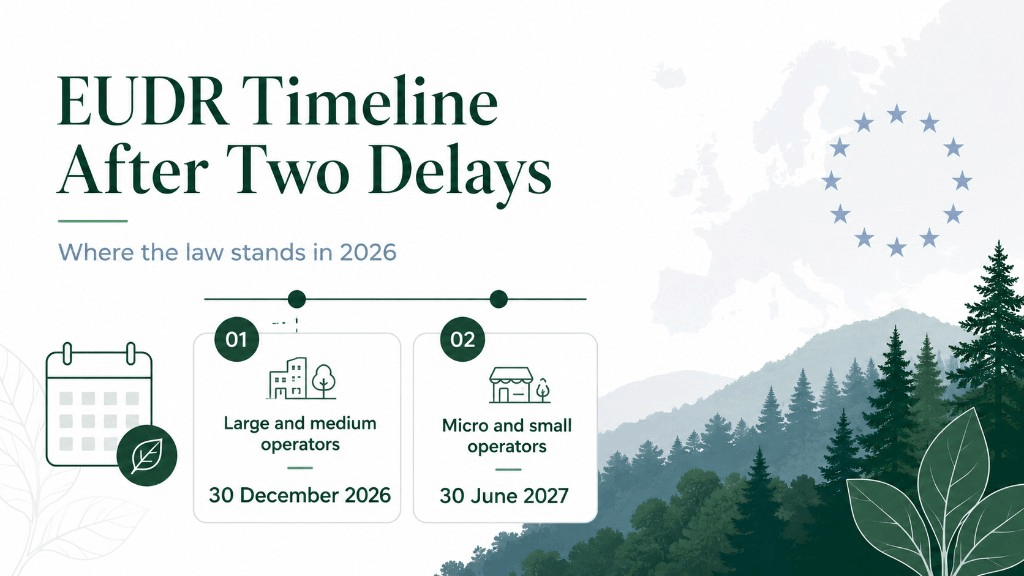
EUDR applies from 30 December 2026 for large and medium operators and 30 June 2027 for micro and small ones. What Regulation (EU) 2025/2650 changed, and what is still only a draft.
6 min read

The EUDR's scope, the three conditions every product must meet, the 31 December 2020 cut-off, and what due diligence actually consists of.
6 min read
Regulation & scope
What Regulation (EU) 2023/1115 covers, when it bites, and what changed in the amendments.
2 articles
Roles & obligations
Which role your company holds in a supply chain, and what that role has to do.
2 articles
Geolocation data
Plot geometry: what to collect, what shape it has to be, and what fails validation.
2 articles
Risk & benchmarking
Country tiers, risk assessment, mitigation, and the evidence that has to survive a check.
4 articles
Filing & enforcement
Getting a statement into the EU Information System, and what happens to companies that get it wrong.
2 articles
Commodity guides
One guide per relevant commodity: what is in scope, where the chain mixes, and what changed in July 2026.
7 articles
EUDR software
Short landings for the queries teams type into Google — each opens into the matching ERWAY module.
EUDR glossary
Roles, geolocation, risk tiers and filing vocabulary, aligned with how ERWAY talks about the same checks.
Commission classification of countries of production into low, standard or high risk under Implementing Regulation (EU) 2025/1093 — it sets diligence depth and check rates, not whether you collect plots or file.
31 December 2020 — the date after which deforestation (and, for wood only, forest degradation) disqualifies relevant products as deforestation-free.
The filing by which the first-placing operator formally declares that due diligence was carried out and that risk is negligible — required at every country risk tier.
The person who first places a relevant product on the EU market, or exports it — and who files the Due Diligence Statement for that placing.
Land within a single real-estate property, homogeneous enough that deforestation risk can be assessed as one unit — not an arbitrary farm name that mixes unlike patches.
One of the seven commodities named by Regulation (EU) 2023/1115: cattle, cocoa, coffee, oil palm, rubber, soya and wood — products in scope only when listed in Annex I.
EUDR deadline tracker
Interactive Q&AThis short guided Q&A applies Regulation (EU) 2023/1115 as amended by Regulation (EU) 2025/2650 to your situation. Pick an answer at each step — you get an indicative application date and where ERWAY can help next.
Question 1 of 6
Path adapts to your answers
Question 1
Cattle, cocoa, coffee, oil palm, rubber, soya, wood and derived products listed in Annex I — placed on the EU market, made available, or exported where the regulation applies.
Select one answer below to continue
General information on EU Regulation 2023/1115, not legal advice. Always check the Official Journal and your counsel before relying on a date.
ERWAY turns supplier plot geometry into deforestation risk intelligence and a submission-ready EU Due Diligence Statement. Take the two-minute interactive tour.