
Country benchmarking: what the risk tiers change, and what they don't
Roughly 140 countries are classified low risk, which sounds like most of the problem going away. It isn't. The tier changes how much analysis you do — not whether you collect plot data or file a statement.

On this page
When the Commission published the first country benchmarking list in May 2025, a lot of compliance programmes quietly slowed down. The headline number was striking: only four countries classified as high risk, and the overwhelming majority — roughly 140 — classified as low. If almost everywhere is low risk, the reasoning went, how much of this really applies to us?
More than that reading suggests. The benchmarking system is real and it does reduce work, but it reduces a specific and quite narrow part of it.
How the tiers work
Commission Implementing Regulation (EU) 2025/1093, adopted on 22 May 2025, assigns every country a risk classification for the commodities in scope. The classification drives two things: the depth of due diligence expected of you, and how often competent authorities are required to check operators sourcing from there.
| Tier | Roughly how many countries | Minimum authority checks |
|---|---|---|
High | 4 — Belarus, Myanmar, North Korea, Russia | 9% of operators, plus 9% of the volume placed on the market |
Standard | Around 50 | 3% of operators |
Low | Around 140 | 1% of operators |
The three tiers
The high-risk list is smaller than the debate around it
Only four countries are classified high risk, and the classification rests on the benchmarking methodology rather than on any single measure of forest loss. Several countries with very significant deforestation are classified standard, which is a large part of why the list has been contested.
The list itself
One structural point decides how to read this, and most reproductions of the list get it wrong. The Annex to the implementing regulation names the low-risk and the high-risk countries only. Standard risk is the residual category: it is assigned to every country the Annex does not mention.
So the low and high-risk lists below are complete and authoritative. The standard-risk entries are the principal producing countries for the seven commodities — useful, but a selection rather than the whole set. If a country you source from appears nowhere, that absence is itself the answer.
EUDR country risk classification
The Annex to Implementing Regulation (EU) 2025/1093 names 140 low-risk and 4 high-risk countries. Everything it does not name is standard risk by default.
193 countries shown
Africa
- AlgeriaLow risk
- AngolaStandard risk
- BeninStandard risk
- BotswanaStandard risk
- Burkina FasoStandard risk
- BurundiLow risk
- Cabo VerdeLow risk
- CameroonStandard risk
- Central African RepublicLow risk
- ChadStandard risk
- ComorosLow risk
- CongoLow risk
- Côte d’IvoireStandard risk
- Democratic Republic of the CongoStandard risk
- DjiboutiLow risk
- EgyptLow risk
- Equatorial GuineaStandard risk
- EritreaStandard risk
- EswatiniLow risk
- EthiopiaStandard risk
- GabonLow risk
- GhanaLow risk
- GuineaStandard risk
- Guinea-BissauStandard risk
- KenyaLow risk
- LesothoLow risk
- LiberiaStandard risk
- LibyaLow risk
- MadagascarLow risk
- MalawiStandard risk
- MaliLow risk
- MauritaniaStandard risk
- MauritiusLow risk
- MoroccoLow risk
- MozambiqueStandard risk
- NamibiaStandard risk
- NigerStandard risk
- NigeriaStandard risk
- RwandaLow risk
- Sao Tome and PrincipeLow risk
- SenegalStandard risk
- SeychellesLow risk
- Sierra LeoneStandard risk
- SomaliaStandard risk
- South AfricaLow risk
- South SudanLow risk
- SudanStandard risk
- TanzaniaStandard risk
- TogoLow risk
- TunisiaLow risk
- UgandaStandard risk
- ZambiaStandard risk
- ZimbabweStandard risk
Asia
- AfghanistanLow risk
- ArmeniaLow risk
- AzerbaijanLow risk
- BahrainLow risk
- BangladeshLow risk
- BhutanLow risk
- Brunei DarussalamLow risk
- CambodiaStandard risk
- ChinaLow risk
- CyprusLow risk
- Democratic People’s Republic of KoreaHigh risk
- GeorgiaLow risk
- IndiaLow risk
- IndonesiaStandard risk
- Iran (Islamic Republic of)Low risk
- IraqLow risk
- IsraelStandard risk
- JapanLow risk
- JordanLow risk
- KazakhstanLow risk
- KuwaitLow risk
- KyrgyzstanLow risk
- Lao People’s Democratic RepublicLow risk
- LebanonLow risk
- MalaysiaStandard risk
- MaldivesLow risk
- MongoliaLow risk
- MyanmarHigh risk
- NepalLow risk
- OmanLow risk
- PakistanStandard risk
- PalestineLow risk
- PhilippinesLow risk
- QatarLow risk
- Republic of KoreaLow risk
- Saudi ArabiaLow risk
- SingaporeLow risk
- Sri LankaLow risk
- Syrian Arab RepublicLow risk
- TajikistanLow risk
- ThailandLow risk
- Timor-LesteLow risk
- TurkiyeLow risk
- TurkmenistanLow risk
- United Arab EmiratesLow risk
- UzbekistanLow risk
- VietnamLow risk
- YemenLow risk
Caribbean
- Antigua and BarbudaLow risk
- BahamasLow risk
- BarbadosLow risk
- CubaLow risk
- DominicaLow risk
- Dominican RepublicLow risk
- GrenadaLow risk
- HaitiStandard risk
- JamaicaLow risk
- Saint Kitts and NevisLow risk
- Saint LuciaLow risk
- Saint Vincent and the GrenadinesLow risk
- Trinidad and TobagoLow risk
Central America
- BelizeStandard risk
- Costa RicaLow risk
- El SalvadorStandard risk
- GuatemalaStandard risk
- HondurasStandard risk
- NicaraguaStandard risk
- PanamaStandard risk
Europe
- AlbaniaLow risk
- AndorraLow risk
- AustriaLow risk
- BelarusHigh risk
- BelgiumLow risk
- Bosnia and HerzegovinaLow risk
- BulgariaLow risk
- CroatiaLow risk
- CzechiaLow risk
- DenmarkLow risk
- EstoniaLow risk
- FinlandLow risk
- FranceLow risk
- GermanyLow risk
- GreeceLow risk
- HungaryLow risk
- IcelandLow risk
- IrelandLow risk
- ItalyLow risk
- LatviaLow risk
- LiechtensteinLow risk
- LithuaniaLow risk
- LuxembourgLow risk
- MaltaLow risk
- MonacoLow risk
- MontenegroLow risk
- Netherlands (Kingdom of the)Low risk
- North MacedoniaLow risk
- NorwayLow risk
- PolandLow risk
- PortugalLow risk
- Republic of MoldovaLow risk
- RomaniaLow risk
- Russian FederationHigh risk
- San MarinoLow risk
- SerbiaLow risk
- SlovakiaLow risk
- SloveniaLow risk
- SpainLow risk
- SwedenLow risk
- SwitzerlandLow risk
- UkraineLow risk
- United Kingdom of Great Britain and Northern IrelandLow risk
North America
- CanadaLow risk
- MexicoStandard risk
- United States of AmericaLow risk
Oceania
- AustraliaLow risk
- FijiLow risk
- KiribatiLow risk
- Marshall IslandsLow risk
- Micronesia (Federated States of)Low risk
- NauruLow risk
- New ZealandLow risk
- PalauLow risk
- Papua New GuineaLow risk
- SamoaLow risk
- Solomon IslandLow risk
- TongaLow risk
- TuvaluLow risk
- VanuatuLow risk
South America
- ArgentinaStandard risk
- BoliviaStandard risk
- BrazilStandard risk
- ChileLow risk
- ColombiaStandard risk
- EcuadorStandard risk
- GuyanaLow risk
- ParaguayStandard risk
- PeruStandard risk
- SurinameLow risk
- UruguayLow risk
- VenezuelaStandard risk
Low and high-risk entries are the complete Annex lists, verbatim. Standard-risk entries are the principal producing countries and are not exhaustive. Classifications are reviewable and were due to be revisited in 2026 — check the current Implementing Regulation before relying on this.
Two names worth checking against your own records
Ghana is classified low risk while Côte d’Ivoire is standard — a distinction that matters a great deal to anyone sourcing cocoa from West Africa. The Annex also uses formal state names throughout, so a supplier master keyed on common names will not join to it cleanly.
How a classification is decided
The assessment is quantitative first and qualitative second. The primary inputs are the rate of deforestation and forest degradation in a country, and the rate of expansion of agricultural land used for the commodities in scope — drawn largely from international datasets rather than from national self-reporting.
Beyond those headline measures, the regulation allows a range of further considerations to be taken into account, including the existence and enforcement of laws protecting forests, the presence of agreements between the country and the EU, and whether the country has made and is implementing commitments on deforestation and forest degradation.
Classification can be sub-national
The system provides for parts of a country to be classified separately, not only whole countries. That matters for large producing countries where forest pressure is concentrated in particular regions — and it means "which country" is not always a precise enough question about your own sourcing.
What a low-risk classification actually buys you
Sourcing from a low-risk country gives access to simplified due diligence. Concretely, that means the risk assessment and risk mitigation steps are not required — provided you have no information pointing to non-compliance, and no substantiated concern has been raised.
That is a genuine saving. Risk assessment and mitigation are the analytically demanding parts of the exercise, and being able to stand them down across most of a supplier base is material.
What it does not touch is the information-collection duty. You still collect the geolocation of every plot. You still file a due diligence statement. You still keep records for five years. Simplified due diligence is a reduction in analysis, not an exemption from evidence — the full obligation-by-obligation comparison is set out in the tier-by-tier matrix.
The expensive misreading
Teams that read the benchmarking announcement as removing the geolocation requirement and paused data collection have the furthest to travel before December. Plot geometry is the longest-lead item in the whole programme, and it is required at every tier.
The conditions attached
Simplified due diligence is conditional, and the conditions are not passive. Before relying on it you must have ascertained that there is no reason for concern, which means an initial examination rather than an assumption. And it lapses the moment you become aware of any information pointing at risk of non-compliance.
The trigger is a substantiated concern — in the Commission's framing, a duly reasoned claim based on objective and verifiable information. Once one exists, the simplified route closes and full due diligence resumes, retrospectively as far as the affected goods are concerned.
This is worth designing for rather than reacting to. A programme that can only operate in simplified mode has no gear to change into when an NGO report names one of its sourcing regions.
The Parliament objection, and why it changed nothing
In July 2025 the European Parliament adopted a resolution objecting to the benchmarking methodology and its results, citing concerns about data quality, methodological robustness and transparency. It was widely reported, and frequently reported as the list being rejected.
It was not. The resolution was a political signal rather than a legal act with the effect of annulling the implementing regulation, and the classifications remained in force throughout. Any compliance decision taken in 2025 on the basis that the tiers had been struck down was taken on a misreading.
What the objection did do is make revision more likely, and the Commission had already committed to revisiting the benchmarks in 2026 on updated data.
Tiers move, so treat them as a feed
A classification is a snapshot of a methodology applied to a dataset at a point in time. Both change. A country moving from low to standard reinstates the full risk assessment obligation for everything you source from it — with no transition period built into your own processes unless you built one.
Store the tier as data, not as a policy statement
It belongs next to the country of production in your systems, where a change can be applied mechanically rather than discovered in a meeting.
Keep collecting plot geometry everywhere
It is required at every tier, and it is the thing that makes a tier change survivable rather than catastrophic.
Have a full-diligence path ready even where you use the simplified one
Substantiated concerns arrive without notice. The capability has to pre-exist the trigger.
Watch the 2026 review
A revised list is the single most likely event to change the shape of your obligations in the next year.
The benchmarking system is best understood as a calibration of effort rather than a filter on obligation. It tells you how hard to look. It never tells you that you may stop looking.
A note on countries in the middle
One detail worth holding on to: the risk assessment considers the classification of the country of production and of any country the commodity passed through on its way to you. Those are frequently not the same place, and the second is easy to overlook when procurement records name only the immediate supplier.
A commodity grown in a low-risk country, processed and re-exported through a standard-risk one, does not simply inherit the classification of wherever it started. Where a route introduces opportunities for mixing with material of unknown origin, that is precisely the kind of supply chain complexity the assessment is meant to weigh — and the tier of the country of production alone will not tell you about it.
Primary sources
- 1.
- 2.
- 3.
Published · Updated · Last reviewed against the sources listed above.
Fredrich Johnson
Compliance Editor
I read the consolidated text and the Commission guidance so compliance teams do not have to, and edit every regulation-scope and enforcement piece before it publishes.
Read next
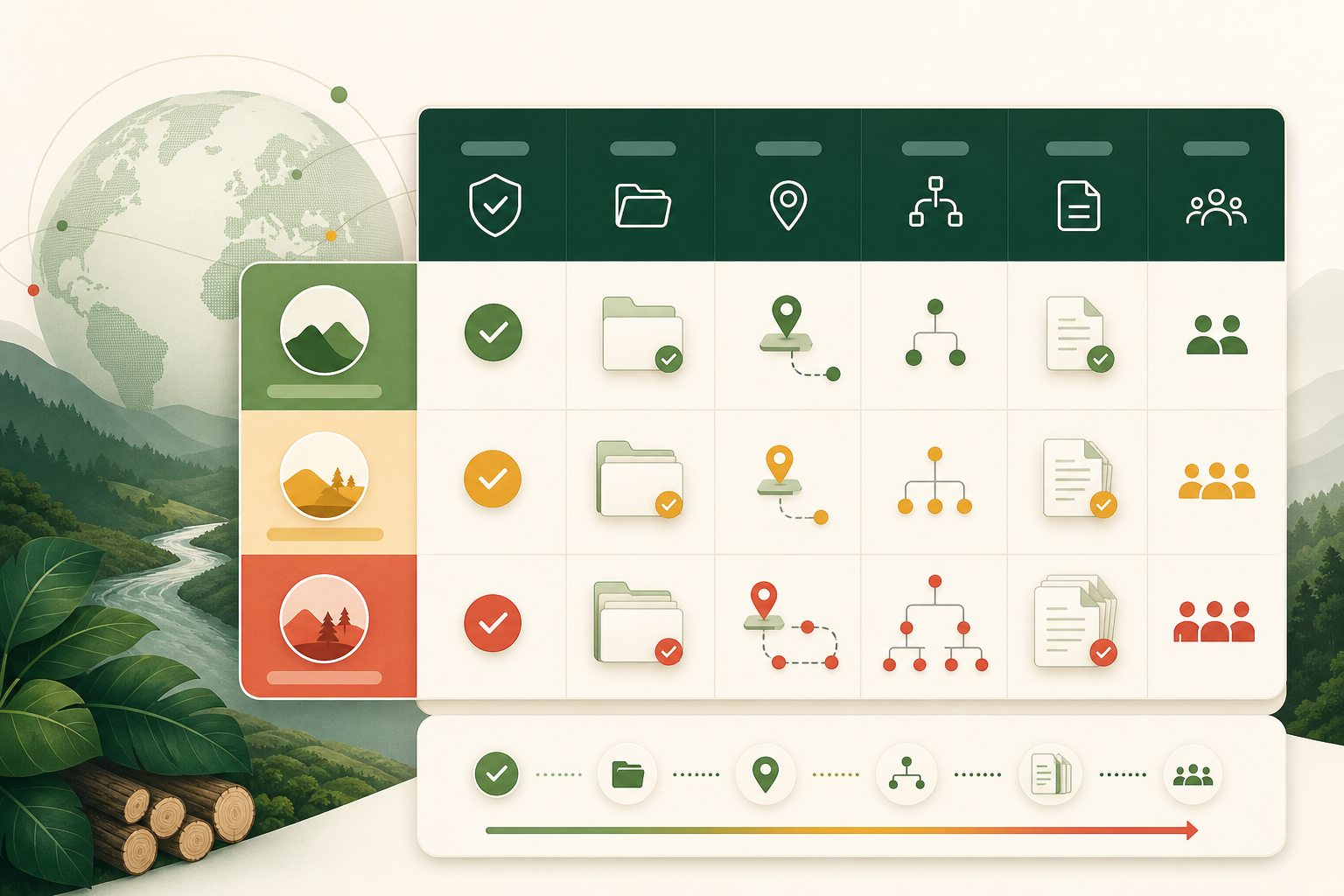
EUDR country risk classification: which obligations change, tier by tier
A complete tier-by-tier comparison of EUDR obligations: information collection, due diligence systems, risk assessment, mitigation, mixing rules, substantiated concerns and authority check rates.
6 min read
Risk assessment and mitigation: building an evidence file that holds up
What EUDR risk assessment has to cover, what 'negligible risk' and 'substantiated concern' mean in practice, and how to document mitigation so it survives a competent authority check.
6 min read

Supplier questionnaires: proving EUDR readiness before the first plot lands
Why EUDR teams should run supplier questionnaires early: readiness signals, dynamic legality questions, risk scoring, and how ERWAY turns builder → send → results into an audit-ready PDF.
3 min read