
Wood and timber under the EUDR
Wood is the only commodity with a predecessor regime, the only one where forest degradation is a live test, and the only one that has to declare a species. It also has the widest scope in Annex I by a distance.

On this page
Everyone else in this regulation is starting from nothing. The timber trade is not: it has been operating under the EU Timber Regulation since 2013, has due diligence systems, has supplier declarations, has a decade of muscle memory. That is an advantage, and it is also the source of the sector's characteristic mistake, which is assuming the new regime is the old one with a wider product list.
It is not. The EUTR asked whether timber was legally harvested. The EUDR asks that, and then asks a second, entirely separate question about the land — was it forest on 31 December 2020, and has it been converted or degraded since. A due diligence system built to answer the first question well will answer the second not at all, because it was never designed to know where anything came from at a plot level.
What is in scope
| Codes | Products |
|---|---|
| 4401–4421 | The whole of chapter 44: fuel wood, charcoal, roundwood, sawnwood, veneer, particle board, fibreboard, plywood, densified wood, frames, packing cases and pallets, casks, tools, joinery, tableware, marquetry and other articles of wood |
| Chapters 47 and 48 | All pulp and paper, excepting bamboo-based and recovered (waste and scrap) products |
| ex 49 | Printed books, newspapers, pictures and other products of the printing industry, of paper |
| ex 9401 | Wooden seats — narrowed in July 2026 to a specific list, taking aircraft and motor vehicle seats out |
| 9403 30–9403 91 | Wooden furniture and parts thereof |
| 9406 10 | Prefabricated buildings of wood |
Wood in Annex I
Two features of that list do most of the damage to a scoping exercise. The first is that chapters 47 and 48 are covered wholesale rather than heading by heading — every grade of pulp, every kind of paper and paperboard, cartons, labels, tissue, cigarette paper, envelopes. The second is chapter 49: printed matter. A publisher importing books printed outside the Union is placing a relevant product on the market, and so is a business importing printed packaging or promotional material.
Two carve-outs worth knowing
Recovered paper and paperboard is excepted from the chapters 47 and 48 entry, and the Annex preamble excludes goods made entirely from material that has completed its lifecycle and would otherwise be waste — so genuinely recycled fibre is outside the regime. Separately, the 4415 entry does not cover packing material used exclusively to support, protect or carry another product placed on the market: the pallet you sell is in scope, the pallet your goods arrive on is not.
The July 2026 delegated act touches wood only lightly, replacing the open ex 9401 seats entry with a specific list of wooden seats. The practical effect is that aircraft and motor vehicle seats fall out — a sensible narrowing, since the wood content of a car seat frame is incidental to a product nobody would describe as a timber good.
Degradation is a live test, and it is narrower than you think
Article 3 requires relevant products to be deforestation-free, and for wood the definition carries a second limb: free from forest degradation occurring after 31 December 2020. Wood is the only commodity where this applies, and it is the provision most often described inaccurately.
Degradation under this regulation is a structural conversion between forest classes: primary or naturally regenerating forest becoming plantation forest, planted forest, or other wooded land. That is the whole of it. It is not a measure of forest quality, not a threshold of canopy loss, not selective logging intensity, and not damage from a storm or a fire that nobody induced. A well-managed selective harvest in a natural forest that remains a naturally regenerating forest afterwards is not degradation in this sense, however much biomass it removed.
That narrowness cuts both ways for a compliance programme. It means a great deal of what forestry professionals would call degradation is outside the regulation. It also means the specific thing the regulation does catch — converting natural forest to plantation — is a change that satellite classification can actually detect, which is why the JRC publishes a global forest type layer alongside its forest cover layer. Distinguishing naturally regenerating forest from planted forest is exactly the discrimination the degradation limb requires.
The geometry problem, plus two fields nobody else has
Harvest coupes are almost always well above four hectares, so wood is a polygon commodity. In managed forestry that is less painful than it sounds: concession boundaries, compartment maps and harvest plans exist as spatial data because forestry has been a mapped profession for a century. Plantation operators generally hold compartment geometry to the metre.
What wood carries that no other commodity does is the requirement, in Annex II, to give the full scientific name of the species where applicable, alongside the ordinary commodity information — and Article 9 asks for the date or time range of production, which for timber means the time of harvest. Species and harvest date are the two fields that make a timber statement different from every other kind.
Species is where mixed products become difficult. A sheet of plywood may be three species from two countries. A tonne of pulp may be a dozen. The declaration has to reflect what is actually in the product, and a supply chain that has always traded on grade rather than botany may never have recorded it. This is a records problem of the same shape as cattle's movement histories: the data is not hard to represent, it simply may not exist upstream.
Where the chain mixes
The sawmill is the first mixing point and the pulp or panel mill is the decisive one. Logs from many coupes are graded and sawn together; chips and fibre from many sources are pulped together. By the time fibre has been through a paper machine, the notion of tracing a sheet to a coupe has no physical meaning at all — the material has been dissolved and reconstituted.
Wood also has the longest chain of the seven, and it crosses borders repeatedly. Logs from one country, sawn in a second, made into panels in a third, assembled into furniture in a fourth, imported into the Union from the fourth. Each transformation is a place where documentation is re-created rather than carried forward, and the operator filing the statement is typically five parties removed from anyone who has ever seen the forest.
This is why wood is the commodity where supplier declarations remain load-bearing despite everything. Nobody is going to satellite-verify a container of assembled furniture back to a coupe. What is verifiable is the coupe data itself, collected at the top of the chain and carried down with the goods — which means the practical unit of compliance for a furniture importer is a supplier's forest source register, not the consignment.
FLEGT, EUTR habits, and what actually changed
The single most consequential change for the timber trade is what happened to FLEGT. Under the EUTR, timber covered by a valid FLEGT licence was treated as legally harvested and was exempt from the due diligence obligation altogether — the licence did the work. Under the EUDR, a FLEGT licence is accepted as evidence for the legality limb and does nothing for the deforestation-free limb.
| Question | Under the EUTR | Under the EUDR |
|---|---|---|
| Legally harvested? | Licence satisfies it | Licence satisfies it |
| Deforestation- and degradation-free? | Not asked | Licence is irrelevant — plot data required |
| Due diligence required? | Exempt | Required in full |
What a FLEGT licence does under each regime
An importer with a long-standing FLEGT-licensed flow from a partner country has, in EUDR terms, solved one half of a two-half problem and has no plot geolocation at all. That is the most common starting position in the tropical timber trade and the one most likely to be mistaken for readiness.
On origins, the benchmarking is favourable to the European trade and neutral elsewhere. All EU member states are low risk, as is most of Europe including Romania; Russia and Belarus are high risk, which effectively closes those flows. Brazil, Indonesia, Malaysia, Cameroon and the Democratic Republic of the Congo are standard risk. High risk brings enhanced scrutiny and a higher share of consignments checked, on top of full assessment and mitigation.
Legacy stock has its own date
Products manufactured before 29 June 2023 — the date the EUDR entered into force — but placed on the market after the application date are covered from 1 January 2029. This matters for slow-moving inventory and for reclaimed or long-held timber, and it is the only place in the regulation where a 2029 date appears.
Filing the statement
The operator first placing the product on the EU market files, which for wood is often a furniture, packaging or paper importer several transformations downstream of the forest. Downstream operators and traders within the Union retain the reference number.
A timber statement carries the ordinary fields plus species and harvest time, and the species field is where submissions most often stall. It expects the scientific name, so a supply chain that records "hardwood" or a trade name has a translation problem before it has a filing problem. For mixed products every species present has to be declared, which for panel and pulp products means the mill's own furnish records become the source of truth.
Common questions
Does the regulation cover bamboo or rattan furniture?
Generally not under the wood entries. Bamboo-based products are explicitly excepted from the chapters 47 and 48 pulp-and-paper entry, and bamboo itself is a grass rather than a tree under the forest definition the regulation uses. Furniture made substantially of bamboo or rattan is typically classified outside chapter 44's wood headings for the same underlying reason — it is worth checking your specific product's CN code, since a bamboo-veneered panel over a wood substrate is a different case from solid bamboo furniture.
Is reclaimed or recycled timber treated the same as recycled paper?
Not automatically. Recovered paper and paperboard has its own explicit exception in the chapters 47 and 48 entry. Reclaimed structural timber repurposed into new products does not have an equivalent named exception — it may qualify under the general waste carve-out in the Annex I preamble if the material genuinely completed its lifecycle as defined in the EU's waste framework directive, but that is a case-by-case legal question rather than a blanket exemption the way recycled fibre enjoys.
Do composite panels like MDF or OSB, made from many species, need a single scientific name?
Annex II asks for the scientific name where applicable, which is exactly the qualifier that exists for products like this. A panel pressed from mixed recovered and virgin fibre from several species may not have one meaningful scientific name to give — what the mill can and should provide is the species composition it actually knows, rather than a single name chosen for convenience.
Is cork covered by the wood entry?
No. Cork is harvested from the bark of cork oak without felling the tree, and cork products are classified in their own customs chapter, separate from chapter 44's wood entries. Cork is not listed anywhere in Annex I and carries no EUDR obligation as a commodity in its own right.
Are cut Christmas trees or other ornamental trees in scope?
Usually not as the wood commodity is defined. A live or freshly cut tree sold whole for ornamental use is typically classified under a heading for cut foliage and trees rather than under the roundwood and sawn-timber headings that make up chapter 44's Annex I entries — worth confirming against the specific CN code your business uses, since the answer turns on classification rather than on the fact that a tree was felled.
The 4415 entry excepts packaging material — does that cover pallets or wooden boxes I sell as a product?
No. The exception is narrow: it covers packing material used exclusively to support, protect or carry another product that is itself being placed on the market — the pallet your goods arrive on, for instance. A pallet, crate or wooden box that you sell as the product in its own right is squarely inside the 4415 entry and needs the same species and geolocation data as any other article of wood.
If my supplier holds a FLEGT licence, do I still need plot-level geolocation?
Yes. A FLEGT licence is accepted as evidence that the timber was legally harvested, which is one limb of the EUDR's test. It says nothing about whether the harvest plot was forest on 31 December 2020 and has not been deforested or degraded since, which is the second limb — and that limb is tested with plot geolocation, not with a licence, regardless of how well-established the FLEGT partnership is.
Does the regulation cover wood pellets used for heating or power generation?
Wood pellets fall under heading 4401, which is explicitly listed — fuel wood, wood in chips or particles, sawdust and wood waste and scrap, whether or not agglomerated into pellets. Biomass energy use does not remove a pellet shipment from scope, in the same way fuel use does not remove palm oil from its entry.
What about paper products made partly from bamboo and partly from wood pulp?
The bamboo exception in the chapters 47 and 48 entry applies to bamboo-based products; a genuinely mixed-fibre paper containing both wood pulp and bamboo fibre sits closer to the wood entry than the exception, and the safer position is to treat it as in scope and document the fibre composition rather than assume a partial bamboo content removes the obligation.
Do I need separate geolocation for each species in a mixed hardwood shipment?
Yes, in the sense that each species present has to be declared against the plots it actually came from — a container mixing three hardwood species sourced from three different coupes needs the species and geolocation data for all three, not a single dominant species standing in for the shipment.
What to do before December
Audit your EUTR system for what it never collected
A mature EUTR due diligence system answers the legality question and holds no plot geolocation. Treat the deforestation limb as a new build rather than an extension, because that is what it is.
Re-examine every FLEGT-licensed flow
The licence no longer exempts. Those are the supply chains most likely to have been left alone for a decade and least likely to have coupe-level geometry attached.
Scope chapters 47, 48 and 49 properly
Paper, packaging and printed matter carry the widest and least-expected exposure in this commodity. Search your import declarations by chapter, not by whether you consider yourself a timber business.
Fix the species records upstream
Scientific names are a filing field with no substitute. A chain trading on grade and trade names has to add botany at the mill, and that is a supplier conversation rather than a system change.
Wood is simultaneously the best-prepared and the most exposed of the seven. Best-prepared because the sector has run due diligence for a decade and its forests are mapped. Most exposed because its scope is enormous, its chains are the longest, it carries an extra legal test and two extra data fields, and its most established compliance instrument — the FLEGT licence — now answers only half the question. The trade's decade of experience is genuinely valuable here. It is just not, on its own, sufficient.
Primary sources
- 1.
- 2.European CommissionCommission updates product scope and digital tools to support EUDR implementation (13 July 2026)Press
Retrieved
- 3.
- 4.European Commission Joint Research CentreGlobal Forest Cover 2020 (GFC2020) — EU Observatory on Deforestation and Forest DegradationDataset
Retrieved
Published · Last reviewed against the sources listed above.
Orcun Soydak
Geospatial Compliance Lead
I work on the plot geometry, the satellite evidence and the validation that sits behind an EUDR due diligence statement.
EUDR glossary
Read next

Natural rubber under the EUDR
What EUDR still covers for natural rubber after the July 2026 removals, why Thailand's low-risk status matters, and where latex loses its identity.
12 min read

Cattle under the EUDR
What EUDR covers for cattle after leather left Annex I, why whole-life establishment history is the real obligation, and how feed exposure works.
11 min read
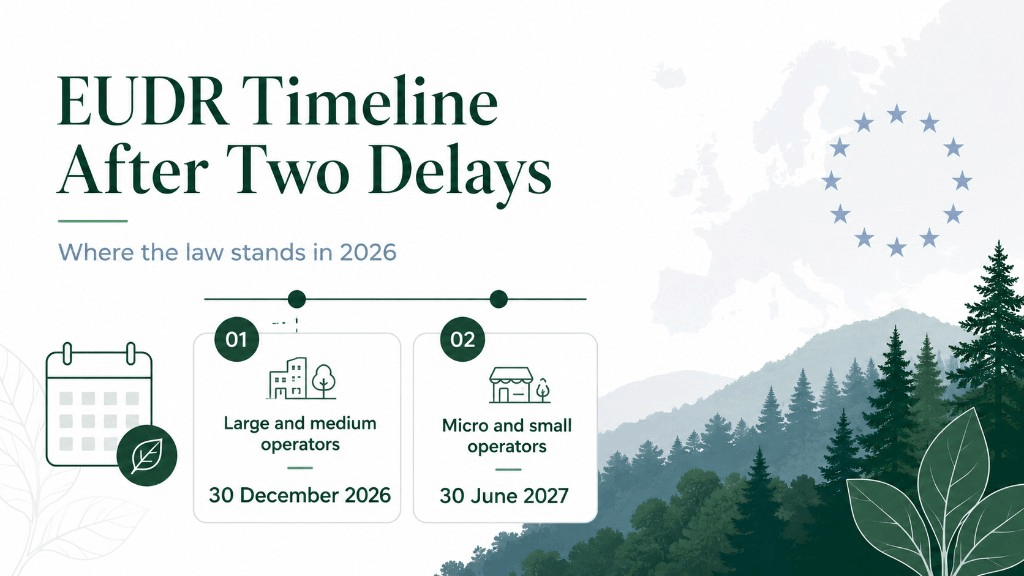
The EUDR timeline after two delays: where the law stands in 2026
EUDR applies from 30 December 2026 for large and medium operators and 30 June 2027 for micro and small ones. What Regulation (EU) 2025/2650 changed, and what is still only a draft.
6 min read