
The EUDR timeline after two delays: where the law stands in 2026
The application date has moved twice, which means most of what is published about EUDR deadlines is wrong. Here is the position as it actually stands, and what the May 2026 package did and did not change.
On this page
If you search for the EUDR deadline you will find three different answers, all published confidently, and two of them are now wrong. The date has moved twice. That history matters less than the current position, but it explains why so much of the material available is unreliable — and why anything you rely on should carry a date.

Where the dates stand
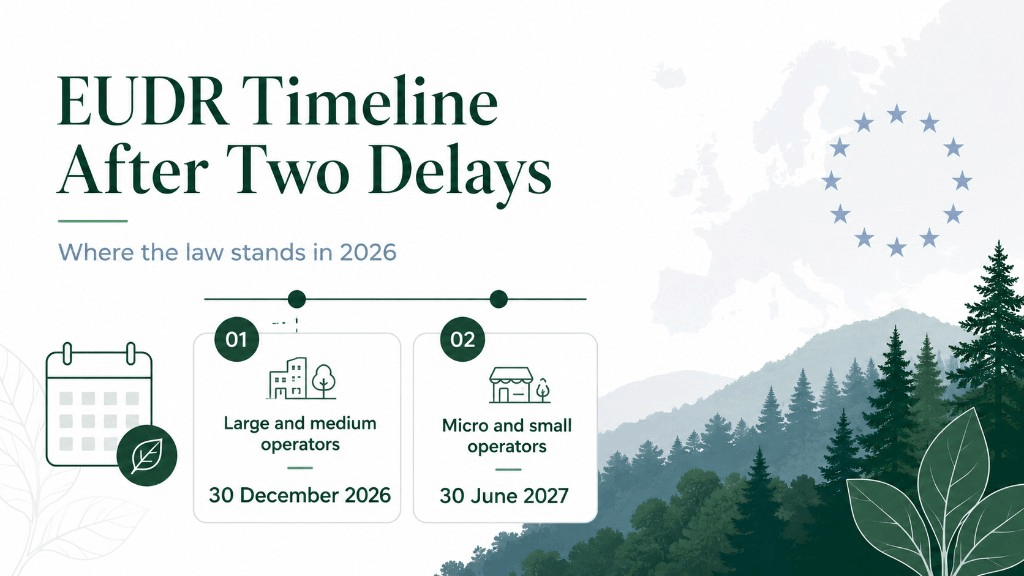
| Who you are | Obligations apply from |
|---|---|
| Large and medium operators and traders | 30 December 2026 |
| Micro and small operators already covered by the EUTR | 30 December 2026 |
| Other micro and small operators, and natural persons | 30 June 2027 |
Application dates by operator category
The carve-out that catches people out
Being a small company does not automatically buy you until mid-2027. Micro and small operators who were already within the scope of the EU Timber Regulation are on the December 2026 date. Timber businesses that assumed the later deadline applies to them have six months less than they think.
What the December 2025 amendment actually changed
Regulation (EU) 2025/2650 was not only a postponement. Alongside the new dates it made structural changes intended to move the administrative weight to the point in the chain where the information actually exists.
- It introduced the concept of a downstream operator, distinct from the operator first placing goods on the market.
- It concentrated the obligation to submit a due diligence statement on that first placer. Downstream operators and traders collect and retain the reference number of the existing statement instead of filing their own.
- It created a simplified declaration, with its content set out in a new annex, for micro and small primary operators sourcing from low-risk countries.
- It required downstream operators and non-SME traders to register in the Information System even though they do not file.
- It confirmed a five-year retention period for supplier and customer records, regardless of company size.
The direction of travel is consistent: fewer statements, filed by fewer parties, with the rest of the chain carrying references. For a large importer that changes relatively little. For a distributor several steps downstream it changes almost everything, because the work shifts from producing evidence to keeping records straight.
The May 2026 package
On 4 May 2026 the Commission published a report to the Parliament and Council, the third edition of its guidance document, the fifth version of the FAQs, and a draft delegated act on product scope.
The guidance and the FAQs are the useful part for anyone preparing now. Between them they clarify several questions that had been answered inconsistently in practice: that a single entity can hold different roles for different products, that downstream actors may rely in good faith on the presumption that their supplier is not an upstream operator unless they are aware of substantiated concerns, and how re-imported goods are treated.
The product-scope changes are a draft
The delegated act proposing to add soluble coffee and certain palm-oil derivatives, and to remove hides, skins and leather, is a draft that went out for feedback. It is not in force, and planning as though it were is a mistake in both directions — do not descope leather yet, and do not assume instant coffee stays out.
The Information System has been rebuilt
Less discussed but more immediately practical: access to the EUDR Information System was restricted from mid-February 2026 while it was reworked, with a staged reopening from June. The rebuild adds registration for the new roles, support for simplified declarations, fuller API integration, and a voluntary facility for grouping reference numbers.
If your plan involves submitting statements through an API rather than by hand, that integration work is now unblocked — and it is worth doing early, because the first time anyone discovers their data model does not fit the submission format is usually the first time they try to submit.
What has not changed
It is worth being blunt about this, because two postponements have created a widespread impression that the regulation is being quietly dismantled. It is not.
- The 31 December 2020 cut-off is untouched.
- The three conditions — deforestation-free, legally produced, covered by a statement — are untouched.
- The requirement to collect plot-level geolocation is untouched.
- The penalty regime, including fines of at least 4% of EU turnover, is untouched.
- The country benchmarking list adopted in May 2025 remains in force.
What moved was when the obligations bite and who files the paperwork. What has to be true about the land, and what evidence you need to hold, has been stable since 2023.
Will it move again?
It is the question every steering committee asks, and it deserves a straight answer rather than an evasion: nobody knows, and betting on it is a poor strategy for reasons that have little to do with prediction.
The case that it might move again is that it has moved twice, that the pressure which produced both postponements — from producing countries, from trading partners and from parts of European industry — has not gone away, and that the simplification agenda is still live.
The case against is more specific. Both previous postponements were argued substantially on the readiness of the IT system and on administrative burden, and both have now been addressed: the Information System has been rebuilt, and the amendment removed the filing obligation from most of the supply chain. The arguments that carried the first two delays have largely been spent.
The asymmetry that settles it
If you prepare and the date slips, you have brought forward work you would have done anyway and gained a year of margin. If you do not prepare and the date holds, you cannot import. The two outcomes are not comparable, which is why the probability is less decision-relevant than it feels.
Planning backwards from December
The temptation after a second delay is to treat the deadline as soft. That reading is hard to defend on the current evidence, and it ignores where the time actually goes. The long pole is not internal system configuration; it is collecting plot geometry from suppliers who have no particular incentive to move quickly.
Work back from December 2026, not forward from today
Data collection from a smallholder network runs in agricultural seasons, not sprints. There may be fewer collection windows left than there are months.
Treat the delay as budget, not relief
The companies in the best position used the first postponement to finish traceability. The ones in the worst position used it to stop.
Separate what is settled from what is draft
Build against the regulation as it stands. Track the delegated act, but do not restructure a product line on the strength of a consultation.
Primary sources
- 1.EUR-LexRegulation (EU) 2025/2650 amending the EUDR as regards its date of applicationRegulation
Retrieved
- 2.
- 3.
- 4.
Published · Updated · Last reviewed against the sources listed above.
Fredrich Johnson
Compliance Editor
I read the consolidated text and the Commission guidance so compliance teams do not have to, and edit every regulation-scope and enforcement piece before it publishes.
EUDR glossary
Read next

EUDR in plain terms: what Regulation (EU) 2023/1115 actually requires
The EUDR's scope, the three conditions every product must meet, the 31 December 2020 cut-off, and what due diligence actually consists of.
6 min read
Operator, downstream operator, trader: who files what
How EUDR roles work after Regulation (EU) 2025/2650: who submits a due diligence statement, who retains reference numbers, and who registers without filing.
6 min read

Cocoa under the EUDR
What EUDR covers for cocoa, why the geometry problem is one of volume rather than difficulty, and where the chain stops being traceable.
13 min read