
Operator, downstream operator, trader: who files what
After the 2025 amendment the due diligence statement is filed once, by whoever first places the goods on the EU market. Everyone downstream carries a reference number. Working out which one you are is now the first question, not a footnote.
On this page
For the first two years of the EUDR's life, one of the most expensive questions a company could get wrong was how many due diligence statements it needed to file. The original design had obligations rippling down the chain, and businesses several steps from any farm were budgeting to file statements about plots they would never see.
The December 2025 amendment settled it. The statement is filed once, at the point of entry, by the party best placed to know where the commodity came from. Everyone after that carries a reference.
The three roles
| Role | What it is | Files a statement? |
|---|---|---|
| Primary operator | Places a relevant product on the EU market for the first time, or exports it. Usually the importer, sometimes an EU producer. | Yes |
| Downstream operator | Places on the market a product that already contains, or was made from, goods on which due diligence was already done. | No — retains the reference |
| Trader | Makes a relevant product available on the market in the course of commercial activity, without being the first to place it. | No — retains the reference |
What each role has to do
The dividing line is first placing. If the goods have already been placed on the EU market by someone else, and a statement already exists covering them, your job is to hold the reference number and be able to produce it — not to redo the work.
Roles attach to products, not to companies
This is the clarification that resolves most confusion, and the Commission's own guidance makes it explicitly. A single legal entity can be a primary operator for one product, a downstream operator for another and a trader for a third, simultaneously.
A manufacturer that imports cocoa beans directly, buys palm oil from an EU distributor, and resells finished bars to retailers is a primary operator on the beans, a downstream operator on the palm oil, and a trader on the bars. There is no single answer to "what are we under the EUDR" for that company, and looking for one wastes months.
The practical consequence
Role determination belongs in your product master data, not in a policy document. It is an attribute of a SKU and a sourcing route, and it changes when you change supplier.
Obligations sit with the legal entity, not the group
A related point that catches large organisations: the obligations apply per legal entity. A subsidiary is assessed on its own footing, not as part of a group. Size classification, which decides your application date, works the same way.
For groups with many importing entities this means the compliance programme has to be built entity by entity even when procurement is centralised — and that the convenient assumption that "the group handles EUDR" is not one anyone can rely on when a competent authority arrives at a specific subsidiary.
What a downstream operator actually owes
Not filing is not the same as doing nothing. The obligations that remain are lighter but real.
- Collect the reference number of the due diligence statement covering the goods, and keep it.
- Retain records of who supplied you and who you supplied, for five years.
- Register in the Information System, if you are not an SME.
- Act if you become aware of a substantiated concern, rather than passing the goods on regardless.
That last one is the substantive duty hiding inside an administrative role. Guidance is clear that downstream actors are not expected to actively police their suppliers' regulatory status, and may rely in good faith on the presumption that a supplier is not an upstream operator — but that presumption ends the moment you are aware of a duly reasoned, objectively verifiable concern. At that point you are expected to stop and check, not to continue on the basis that filing was somebody else's job.
Export is placing too
One category is regularly missed entirely, because the regulation is usually discussed as an import rule. It is not only an import rule. Exporting relevant products out of the EU carries obligations as well, and an EU manufacturer shipping to a non-EU market is an operator for those goods.
For businesses that both import raw material and export finished product, the consequence is two separate positions to manage on what feels like a single flow: obligations on the way in, and obligations on the way out. Companies that scoped their programme around customs import codes alone tend to discover the export side late.
Reference numbers are now a supply chain artefact
The shift from filing to referencing sounds like a simplification, and for effort it is. For systems it is a new problem: a reference number has to travel with goods through purchase orders, delivery notes, invoices and warehouse records, survive consolidation and splitting, and still be retrievable five years later against a specific consignment.
Most ERP configurations have nowhere to put it. The companies that have handled this well treated the reference number as a first-class field at the point they designed the change, rather than parking it in a free-text comment box that nobody can query when an authority asks.
Consolidation is where references get lost
One statement covering a shipment that is then split across six customers, or six shipments blended into one batch, is where reference tracking usually breaks. Decide how your system handles the many-to-many case before it happens, not during an inspection.
How to settle your own position
Take it product line by product line
For each line, ask a single question: is this the first time these goods are placed on the EU market? That answer decides the role.
Check whether a statement already exists upstream
If your supplier is an EU business that imported the goods, it very likely does. If you are importing directly, it does not, and it is yours to file.
Register even if you do not file
Non-SME downstream operators and traders have a registration obligation regardless.
Give the reference number a home in your systems
A field, not a comment. Queryable, and attached to the consignment rather than the supplier.
Getting this right early is unusually valuable, because it determines the size of everything else. A company that concludes it is a downstream operator across most of its portfolio has a records problem. One that concludes it is a primary operator has a traceability problem — and those are different projects with different budgets and very different timelines.
Size sits alongside role
Role decides what you do. Size decides when you have to start doing it, and occasionally how much detail is required. The two are independent, and both have to be settled before a plan means anything.
The classifications follow the EU's general definitions of micro, small, medium and large undertakings, applied — as above — to the legal entity rather than the group. A small subsidiary of a large group is assessed on its own figures, which is favourable more often than companies expect, and a trap when the reverse assumption is made.
The interaction that catches people is the timber carve-out: micro and small operators that were already within the scope of the old EU Timber Regulation are on the December 2026 date rather than the June 2027 one. A small timber importer therefore gets no additional time despite its size, which is the single most commonly mis-stated deadline in the whole regime.
Primary sources
- 1.EUR-LexRegulation (EU) 2025/2650 amending the EUDR as regards its date of applicationRegulation
Retrieved
- 2.
- 3.
Published · Updated · Last reviewed against the sources listed above.
Fredrich Johnson
Compliance Editor
I read the consolidated text and the Commission guidance so compliance teams do not have to, and edit every regulation-scope and enforcement piece before it publishes.
Read next
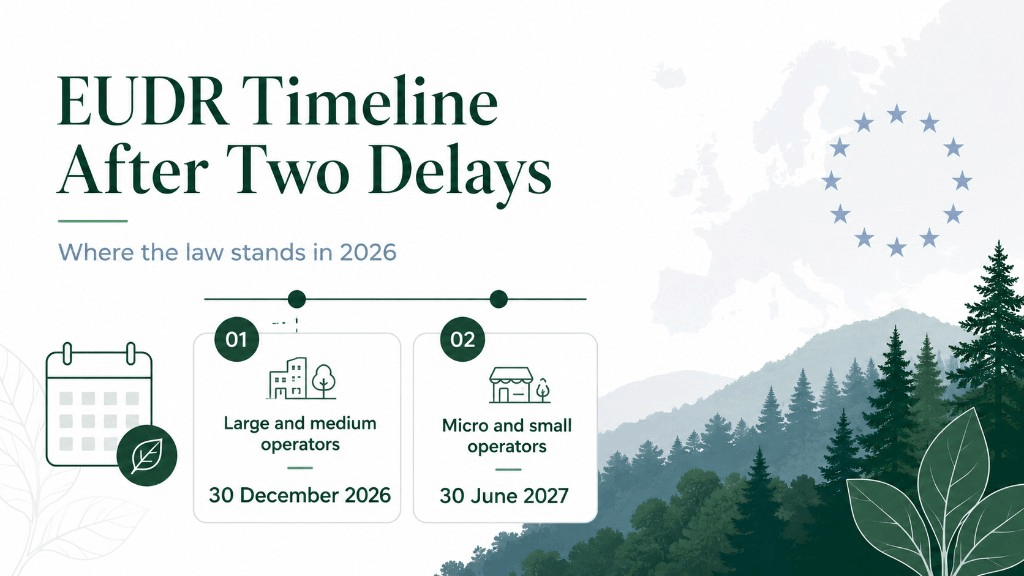
The EUDR timeline after two delays: where the law stands in 2026
EUDR applies from 30 December 2026 for large and medium operators and 30 June 2027 for micro and small ones. What Regulation (EU) 2025/2650 changed, and what is still only a draft.
6 min read

The Due Diligence Statement and the EU Information System, end to end
What goes into an EUDR due diligence statement, how it reaches the EU Information System, what the reference number is for, and what the 2026 rebuild changed.
6 min read

Does certification make you EUDR compliant?
Why there is no such thing as EUDR certification, what third-party schemes can genuinely contribute to risk assessment, and the gaps you still have to fill yourself.
6 min read