
EUDR in plain terms: what Regulation (EU) 2023/1115 actually requires
Seven commodities, three tests, one cut-off date. Most of the complexity people associate with the EUDR comes from the evidence it demands, not from the rule itself — which is short enough to state in a paragraph.
On this page
The EU Deforestation Regulation is short. The obligation it creates fits in a sentence: if you put certain commodities on the EU market, you have to be able to show the land they came from was not deforested after the end of 2020, that they were produced lawfully where they were grown, and that you have filed a statement saying so.
Everything difficult about the EUDR follows from that word "show". The rule is simple; assembling evidence for it across a supply chain that runs through cooperatives, traders and processors is not. It helps to separate the two.
What is covered
Seven commodities sit at the base of the regulation: cattle, cocoa, coffee, oil palm, rubber, soya and wood. On its own that list is misleading, because the regulation does not only cover the raw commodity. It covers a long list of derived products, identified by customs classification code in Annex I.
That is where most scoping surprises come from. A furniture importer is dealing with wood. A tyre manufacturer is dealing with rubber. A chocolate manufacturer is dealing with cocoa, and also possibly with palm oil. Companies that have never thought of themselves as agricultural find themselves in scope because of a component several steps removed from anything that grew.
Scope is decided by customs code, not by self-description
The practical first step for any company is not a discussion about whether you are an agricultural business. It is pulling your customs classification codes and checking them against Annex I. That answer is objective; opinions about it are not.
The three tests
A relevant product may be placed on the market, made available or exported only if it satisfies all three of the following. They are cumulative — passing two is passing none.
Deforestation-free
The commodity was produced on land that was not subject to deforestation after 31 December 2020. For wood there is an additional condition: it must have been harvested without inducing forest degradation after that same date.
Produced in accordance with the relevant legislation of the country of production
This is the legality test, and it is broader than people expect. It reaches land-use rights, environmental protection, forest-related rules, third-party rights, labour rights, human rights protected under international law, the principle of free, prior and informed consent, and tax, anti-corruption, trade and customs rules.
Covered by a due diligence statement
A statement has to have been submitted before the goods are placed on the market or exported.
The second test is the one most often underestimated. A plot can be entirely deforestation-free and still fail, because the legality condition asks a much wider question than whether trees were cut. It is a statement about how the commodity was produced, under the law of the place it was produced in.
The cut-off date, and what it is not
31 December 2020 is the line. Land converted from forest to agricultural use after that date produces commodities that cannot be placed on the EU market, however lawful the conversion was locally and whoever did it.
Two things follow that are worth stating plainly. First, the cut-off is retrospective: it describes events that have already happened, and no amount of subsequent good practice changes what a satellite record shows for 2021. Second, it is a property of the land rather than a deadline for your company — a distinction that gets lost when the cut-off and the application dates are drawn on the same timeline.
Legal locally, non-compliant for the EU
There is no contradiction here and no unfairness argument to be made. The regulation is a market-access condition, not a judgement about another country's law. Land cleared entirely lawfully in 2022 simply cannot supply this particular market.
What "due diligence" actually means here
The phrase is doing specific work in this regulation, and it is not the general corporate sense of taking reasonable care. It names three defined steps.
| Step | What it involves |
|---|---|
| Information collection | Description, quantity, country of production, geolocation of every plot with dates or time range of production, supplier and customer details, and evidence that the commodity is deforestation-free and legally produced. |
| Risk assessment | Working out whether there is anything more than a negligible risk that the products are non-compliant, using criteria the regulation sets out — country risk, complexity of the supply chain, prevalence of deforestation in the area, and more. |
| Risk mitigation | Where risk is more than negligible, taking steps until it is not: additional information, audits, supplier support, independent surveys. Products cannot be placed on the market until the risk is negligible. |
The three components of due diligence
The bar in the third step is worth reading twice. It is not "reasonable effort" or "best endeavours" — it is negligible risk, and until you can conclude that, the goods do not move. Several supply chains that were built for cost and speed cannot produce that conclusion at all without being restructured, which is the real reason the regulation has proved so disruptive.
Geolocation is the hinge
Of everything in the information-collection step, one item changes how supply chains have to work: the geolocation of all plots of land where the commodity was produced, with the date or time range of production.
This is what makes the regulation enforceable. Without coordinates, "deforestation-free" is an assertion. With coordinates, it is a question anyone with access to satellite imagery can check, including the authority checking you. It also means traceability has to survive all the way back to the plot — which mass-balance systems, by design, do not do.
The rules about what shape that geolocation takes are covered separately in points, polygons and the four-hectare rule.
Who has to do what
The regulation distinguishes between operators, who place a product on the EU market or export it, and traders, who make it available further down the chain. The 2025 amendment added a further category of downstream operator and moved the filing obligation firmly to the point where goods first enter the market.
The short version: the entity first placing the goods on the EU market carries the due diligence and files the statement. Companies further down collect and retain the reference number of that statement rather than repeating the exercise. Which of those you are is decided per product, not per company — and a single importer can be all three at once for different lines.
Where a team actually starts
Establish scope from customs codes
Match your product codes against Annex I. This is a factual exercise and should take days, not months.
Establish your role, per product line
Whether you file a statement or retain someone else's reference number changes the whole shape of the work.
Map how far back your traceability actually reaches
Not how far your contracts claim it reaches. The gap between the two is the project.
Start collecting plot geometry
It is the longest-lead item by a wide margin, it depends on other people, and no amount of internal effort compresses it at the end.
The operative text is on EUR-Lex, and it is worth reading rather than reading about — it is shorter than most of the commentary written about it, this piece included.
Primary sources
- 1.
- 2.
- 3.
Published · Updated · Last reviewed against the sources listed above.
Fredrich Johnson
Compliance Editor
I read the consolidated text and the Commission guidance so compliance teams do not have to, and edit every regulation-scope and enforcement piece before it publishes.
Read next
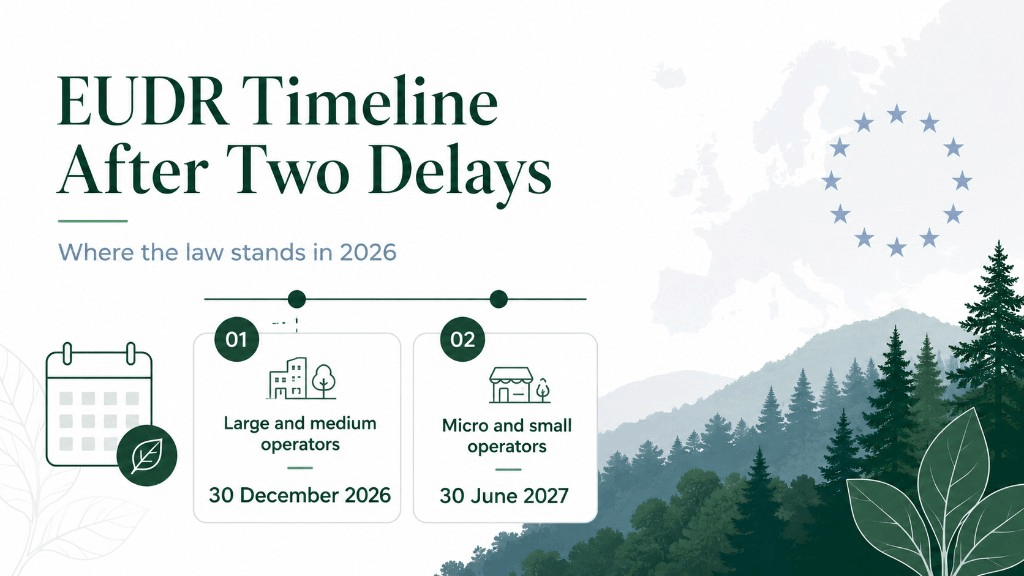
The EUDR timeline after two delays: where the law stands in 2026
EUDR applies from 30 December 2026 for large and medium operators and 30 June 2027 for micro and small ones. What Regulation (EU) 2025/2650 changed, and what is still only a draft.
6 min read
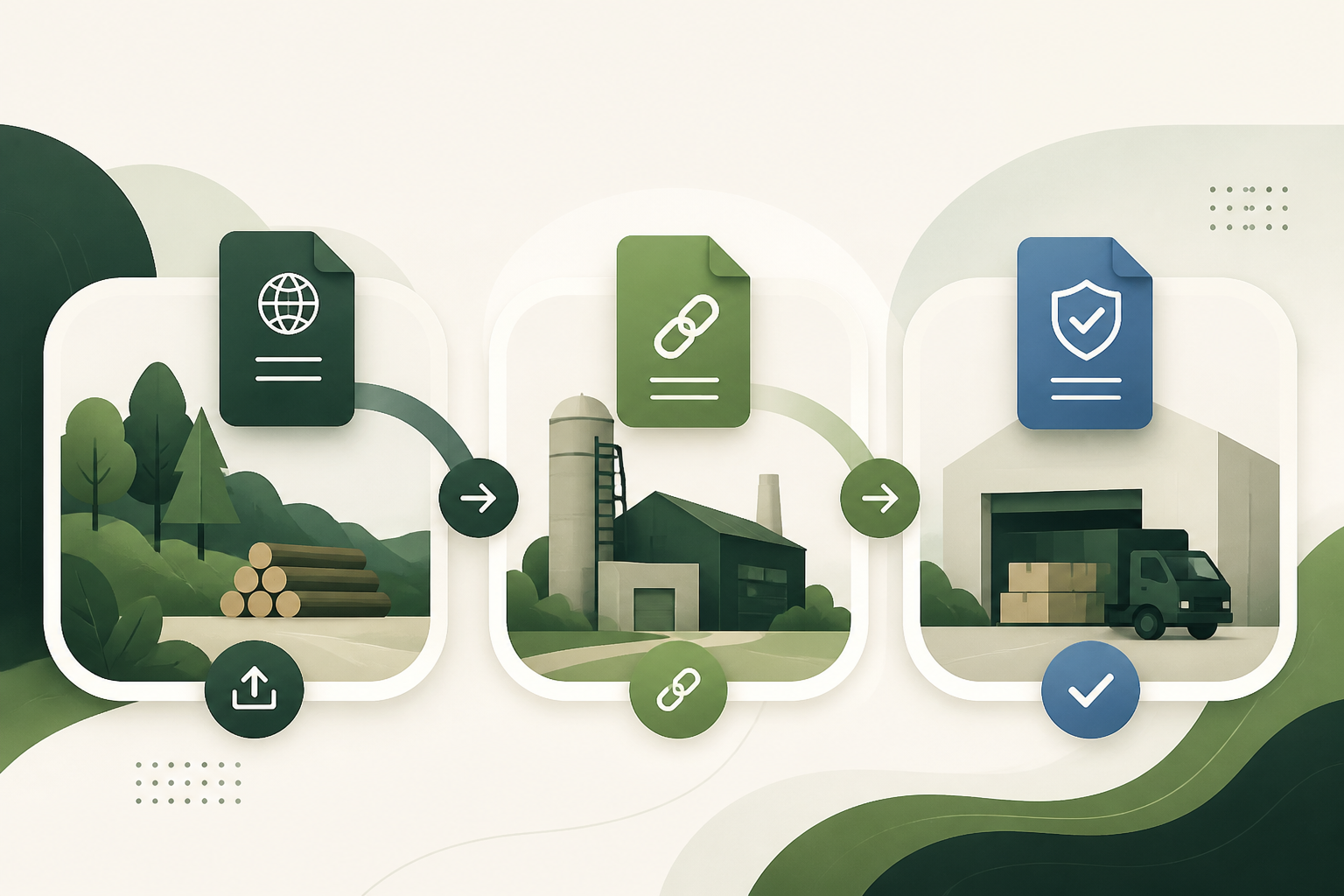
Operator, downstream operator, trader: who files what
How EUDR roles work after Regulation (EU) 2025/2650: who submits a due diligence statement, who retains reference numbers, and who registers without filing.
6 min read

Cocoa under the EUDR
What EUDR covers for cocoa, why the geometry problem is one of volume rather than difficulty, and where the chain stops being traceable.
13 min read