
Low risk
Country benchmarking tier covering roughly 140 countries: Article 9 geolocation and the DDS still apply; Articles 10 and 11 may be skipped only under Article 13’s conditions; authorities check at least 1% of operators.
What it means
Low risk is the Commission’s country-of-production tier for most of the world under Implementing Regulation (EU) 2025/1093 — about 140 countries on the first list. It is named explicitly in the Annex (unlike standard risk, which is the residual).
The tier changes how much analysis you do. It does not remove plot geolocation, the due diligence statement, five-year records, or the duty to keep a documented due diligence system (Article 12).
In the regulation
Where every plot sits in a low-risk country, and the risks of circumvention and of mixing with unknown or higher-tier material are no more than negligible, and no substantiated concern applies, Article 13 allows simplified due diligence: risk assessment and mitigation (Articles 10 and 11) are not required unless information indicates a risk.
Minimum authority checks for low-risk production are 1% of operators each year (Article 16). A substantiated concern ends simplification for the affected goods and puts full diligence back on.
How ERWAY treats it
ERWAY and the field guides treat low-risk origin as a narrower analysis path, not an exemption. Geometry validation and statement packs still run; the country-risk explorer mirrors the Annex list used in the benchmarking article.
Related terms
- Risk & benchmarkingHigh risk (country)
High risk
Country benchmarking tier under Implementing Regulation (EU) 2025/1093: four countries today, full diligence, and the highest minimum authority check rates (9% of operators and 9% of volume).
- Risk & benchmarkingStandard risk (country)
Standard risk
The residual country tier: every country not named low or high in the benchmarking Annex. Full Articles 10 and 11 apply; authorities check at least 3% of operators.
- Risk & benchmarking
Simplified due diligence
Article 13 path that switches off risk assessment and mitigation when every plot is low-risk and mixing/circumvention risks are negligible — it never switches off geolocation, the DDS, or Article 12.
- Risk & benchmarkingHigh risk (country)
Substantiated concern
A duly reasoned claim based on objective, verifiable information — it reopens full due diligence for affected goods and can end Article 13 simplification.
- Risk & benchmarking
Due diligence system
Article 12 duty to establish, maintain and annually review a documented due diligence system — required at every country risk tier, including fully low-risk programmes.
- Risk & benchmarking
Country benchmarking
Commission classification of countries of production into low, standard or high risk under Implementing Regulation (EU) 2025/1093 — it sets diligence depth and check rates, not whether you collect plots or file.
Keep reading
 Risk & benchmarking
Country benchmarking: what the risk tiers change, and what they don't
How EUDR country benchmarking works, what Implementing Regulation (EU) 2025/1093 classified, what simplified due diligence actually removes, and why the Parliament's objection changed nothing.
6 min read
 Risk & benchmarking
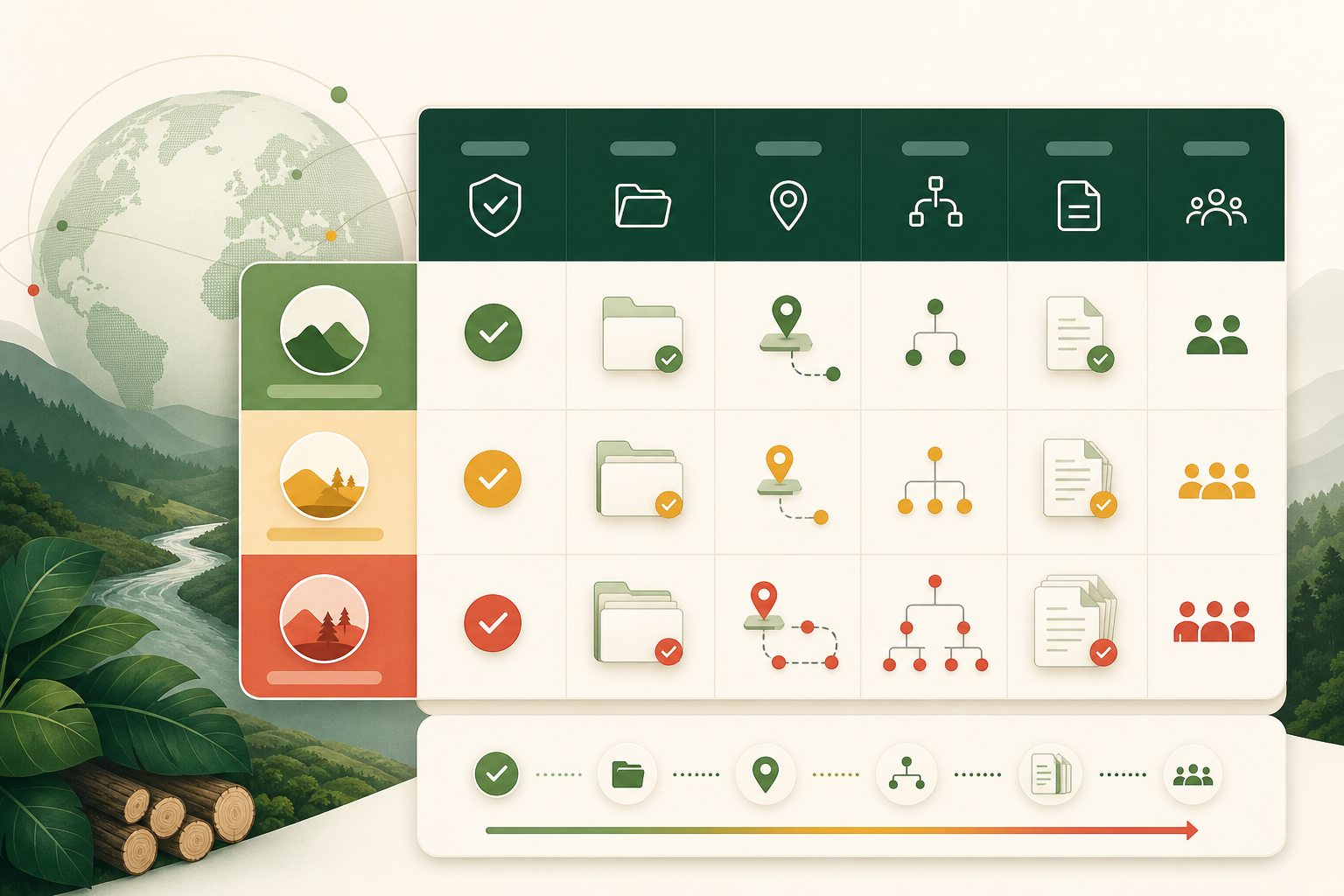
EUDR country risk classification: which obligations change, tier by tier
A complete tier-by-tier comparison of EUDR obligations: information collection, due diligence systems, risk assessment, mitigation, mixing rules, substantiated concerns and authority check rates.
6 min read