
Standard risk
The residual country tier: every country not named low or high in the benchmarking Annex. Full Articles 10 and 11 apply; authorities check at least 3% of operators.
What it means
Standard risk is not a third list the Commission publishes. The Annex to Implementing Regulation (EU) 2025/1093 names low-risk and high-risk countries only. Everything else is standard by default — including many major producing countries for the seven commodities.
If a country you source from appears on neither the low nor the high list, that absence is the classification: treat it as standard risk.
In the regulation
Standard-risk origin means full information collection (Article 9), a maintained due diligence system (Article 12), risk assessment (Article 10), mitigation wherever risk is more than negligible (Article 11), and a filed due diligence statement. Simplified due diligence is not available.
Minimum authority checks are 3% of operators each year (Article 16) — between the 1% low-risk floor and the 9% operator / 9% volume high-risk floor.
How ERWAY treats it
UI badges map standard risk to the medium risk token so tables stay consistent with the three-tier ladder on this site. The country-risk explorer marks standard entries as a curated producing-country set, not an exhaustive Annex list.
Related terms
- Risk & benchmarkingLow risk (country)
Low risk
Country benchmarking tier covering roughly 140 countries: Article 9 geolocation and the DDS still apply; Articles 10 and 11 may be skipped only under Article 13’s conditions; authorities check at least 1% of operators.
- Risk & benchmarkingHigh risk (country)
High risk
Country benchmarking tier under Implementing Regulation (EU) 2025/1093: four countries today, full diligence, and the highest minimum authority check rates (9% of operators and 9% of volume).
- Risk & benchmarking
Country benchmarking
Commission classification of countries of production into low, standard or high risk under Implementing Regulation (EU) 2025/1093 — it sets diligence depth and check rates, not whether you collect plots or file.
- Risk & benchmarking
Risk assessment
Article 10 evaluation of whether relevant products present more than a negligible risk of non-compliance — required at standard and high risk; often skipped only under Article 13.
Keep reading
 Risk & benchmarking
Country benchmarking: what the risk tiers change, and what they don't
How EUDR country benchmarking works, what Implementing Regulation (EU) 2025/1093 classified, what simplified due diligence actually removes, and why the Parliament's objection changed nothing.
6 min read
 Risk & benchmarking
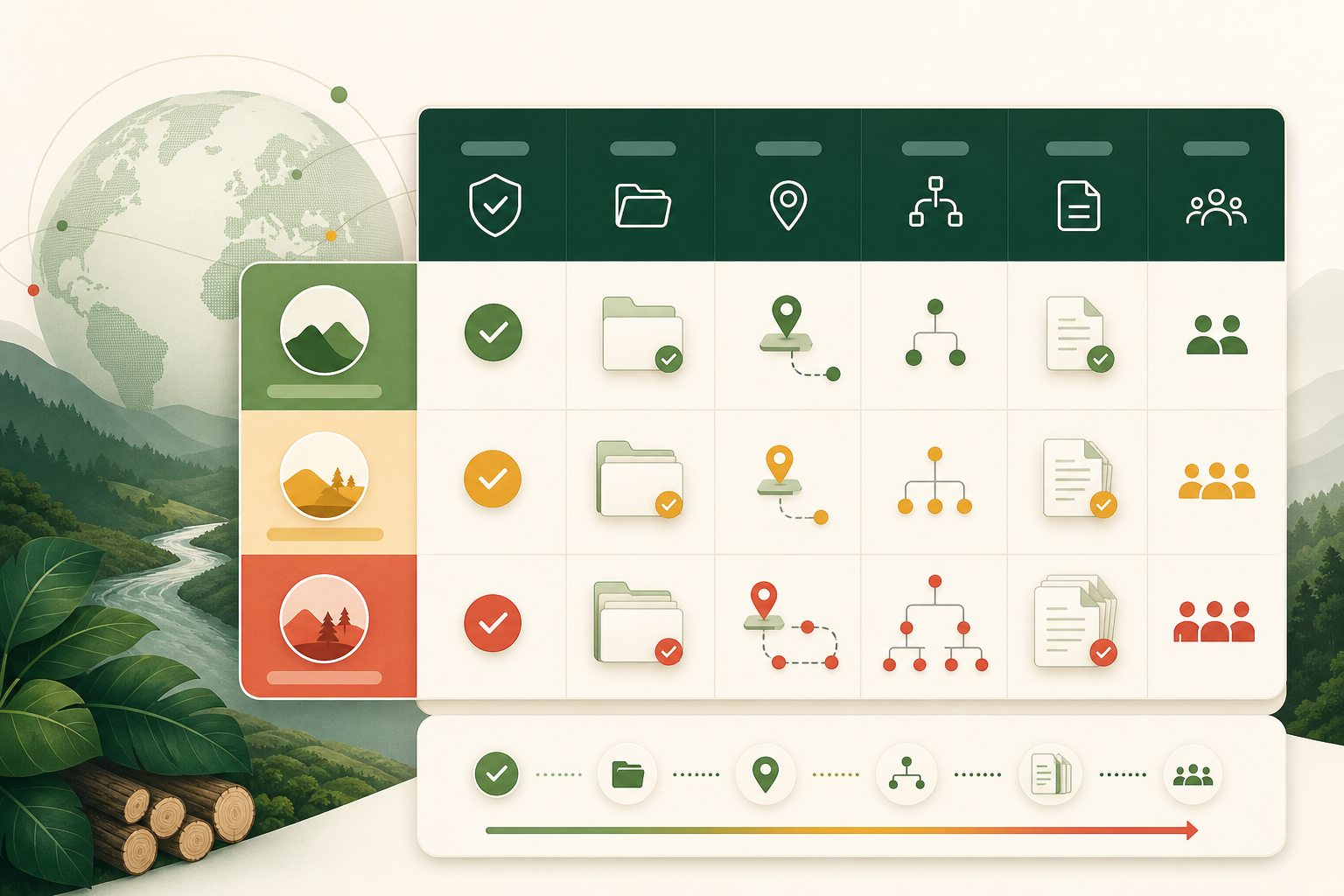
EUDR country risk classification: which obligations change, tier by tier
A complete tier-by-tier comparison of EUDR obligations: information collection, due diligence systems, risk assessment, mitigation, mixing rules, substantiated concerns and authority check rates.
6 min read