
High risk
Country benchmarking tier under Implementing Regulation (EU) 2025/1093: four countries today, full diligence, and the highest minimum authority check rates (9% of operators and 9% of volume).
What it means
High risk is a country-of-production classification, not a score on a single shipment and not a percentage of “content”. It is one of three tiers the Commission assigns for the commodities in scope.
Under the first benchmarking list (May 2025), four countries are high risk: Belarus, Myanmar, North Korea and Russia. The classification follows the Commission’s methodology in Implementing Regulation (EU) 2025/1093 — not a standalone forest-loss percentage that you apply yourself.
In the regulation
High-risk origin closes simplified due diligence (Article 13). Operators still collect geolocation and file a statement; they must also run risk assessment (Article 10) and mitigate wherever risk is more than negligible (Article 11), under closer scrutiny.
Article 16 sets minimum annual checks by competent authorities: for high-risk production, at least 9% of operators and 9% of the quantity placed on the market. Those figures are floors, not targets — Member States may check more. By comparison, the floors are 1% of operators for low risk and 3% for standard risk.
How ERWAY treats it
On this site, high risk uses the same risk-high badge as the country-risk explorer and the obligation matrix. Plot geometry and evidence packs stay required; the tier only raises how hard authorities are expected to look and how heavy assessment must be.
Related terms
- Risk & benchmarkingLow risk (country)
Low risk
Country benchmarking tier covering roughly 140 countries: Article 9 geolocation and the DDS still apply; Articles 10 and 11 may be skipped only under Article 13’s conditions; authorities check at least 1% of operators.
- Risk & benchmarkingStandard risk (country)
Standard risk
The residual country tier: every country not named low or high in the benchmarking Annex. Full Articles 10 and 11 apply; authorities check at least 3% of operators.
- Risk & benchmarking
Country benchmarking
Commission classification of countries of production into low, standard or high risk under Implementing Regulation (EU) 2025/1093 — it sets diligence depth and check rates, not whether you collect plots or file.
- Risk & benchmarking
Simplified due diligence
Article 13 path that switches off risk assessment and mitigation when every plot is low-risk and mixing/circumvention risks are negligible — it never switches off geolocation, the DDS, or Article 12.
Keep reading
 Risk & benchmarking
Country benchmarking: what the risk tiers change, and what they don't
How EUDR country benchmarking works, what Implementing Regulation (EU) 2025/1093 classified, what simplified due diligence actually removes, and why the Parliament's objection changed nothing.
6 min read
 Risk & benchmarking
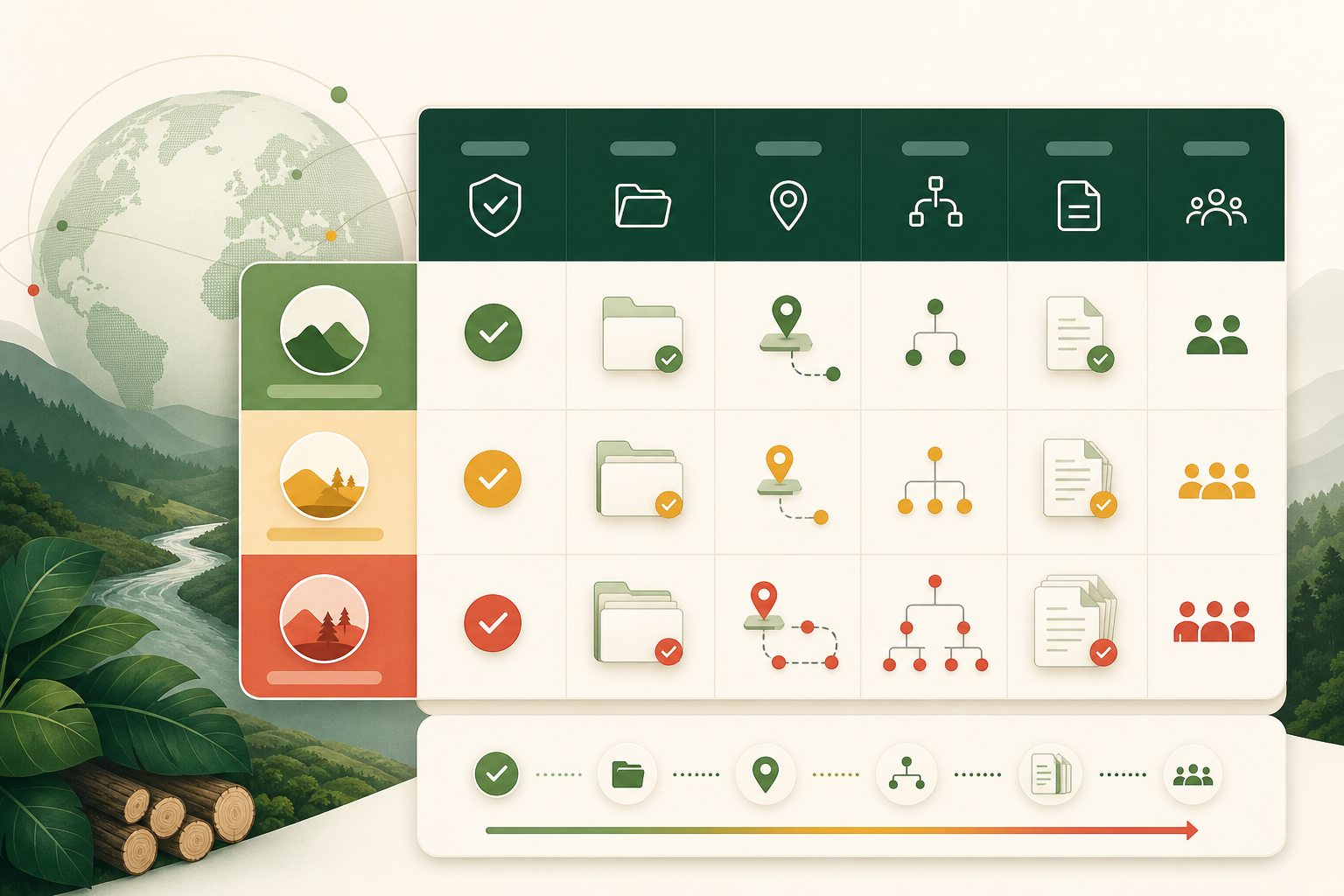
EUDR country risk classification: which obligations change, tier by tier
A complete tier-by-tier comparison of EUDR obligations: information collection, due diligence systems, risk assessment, mitigation, mixing rules, substantiated concerns and authority check rates.
6 min read
 Filing & enforcement
Penalties under Article 25: what non-compliance actually costs
The EUDR penalty regime: fines of at least 4% of EU turnover, confiscation of products and revenues, procurement exclusion, market bans, and the criminal liability layer.
5 min read